Showing posts with label Evolution. Show all posts

Monday, November 15, 2010

Michael Tomasello - Why We Cooperate

cross-posted at Replicated Typo

In this post I will offer a short overview of some aspects of Michael

Tomasello’s latest book „Why We Cooperate,” which is based on his 2008 Tanner Lectures on Human Values.

Tomasello deals with the question howcooperative behaviour and itssocio-cognitive foundations arise both in development and during theevolution of the human species. His short text is accompanied by four short commentaries by leading scholars who contributed in important ways to the theory of the evolution and ontogenetic development Tomasello espouses here. These are: psychologist Carol S. Dweck, anthropologist Joan B. Silk, philosopher Brian Skyrms and developmental psychologist Elizabeth Spelke.

In this post I only want to briefly summarize some of the key tenets of Tomasello’s book to offer an introduction to his work on cooperation, whose main impetus it is to have a closer look at the relatively simple and primal cooperative and interactive social behaviour that builds the foundation of human culture.

The Uniqueness of Human Culture

Tomasello points out that a lot of social animals can be said to have a culture insofar as the same animal species can live in slighty different habitats and show different behaviours (e.g. chimpanzees of different regions have different pant-hoots, many species have regionally differing techniques for obtaining food).
In this regard, human culture is only quantitatively different from that of, say, the other great apes. The difference here is that humans simply have to learn about more culture-specific behaviours and artefacts. The principle however, is the same.
But according to Tomasello, there are two aspects that also make human culture also qualitatively different from all others:

  1. human culture is cumulative. That is, artefacts and behavioural practices often become more complex over time. Every improvement or accepted changed will be transferred to the next generation and so forth.
  2. human culture is unique in that there are social institutions, which create and enforce culture norms and practices.

What underlies these two features “are a set of species-unique skills and motivations for cooperation.” (Tomasello 2009: XIII) on which Tomasello elaborates in the subsequent chapters.

Early Spelke

In the first chapter, “Born (and Bred) to Help”, Tomasello outlines how children come to be (or already are) cooperative so that they can take part in an co-establish human culture.
He advances a theory he dubs “Early Spelke, Later Dweck.”Research done by Tomasello and many others shows that by the time they are about one year old, infants already prove to be cooperative and helpful in many contexts. In addition, these tendencies seem not be taught but come naturally to them given sufficient interaction with a normal environment. (Hence ‘Early Spelke, referring to the work done by Harvard psychologist Elizabeth Spelke on innate or naturally emerging ‘core knowledge’).

Later Dweck
Later in development however, this picture becomes more complex: children come to be concerned about whether others will reciprocate and also about how they are judged by others in the group. They also gradually internalise cultural norms.
Up to now Tomasello has mostly described the initial starting point from which children refine their social behaviour and become truly cultural beings. More precisely, what happens is that children become less ‘indiscriminate’ in terms of who they behave altruistically towards, but become more discerning based on a variety of characteristics.

This phase could be described as the birth of the ‘public self’ which is concerned with ‘impression management.’ The child comes to realize that

“they are targets of the judgements of others who are using social norms as standards.” (Tomasello 2009: 31).

In other words, for the first time they develop a larger we- or group perspective, which is connected to the insight that this ‘we-ness’ is tied to certain social norms (‘They way we do things’).

Experiments show that by the age of three children actively follow social norms and also already participate in enforcing these norms.
If they grasp how a game works, for example, not only do the play it according to the rules, but they also correct others and object if they try to play the game differently.

Interestingly, they also use ‘normative declaratives’ like “One can’t do that” or “It doesn’t work like that,” when doing so.

Those findings contrast sharply with Jean Piaget’s influential view of how social norms are internalised. According to him, (and building on the work of Piaget, moral psychologist Lawrence Kohlberg), children follow social norms only because they fear punishment.

Instead, from and early age on children already seem to adopt some kind of ‘view from nowhere’ (Nagel 1970) and a “he is me” attitude of identification when interacting with others (see also Meltzoff 2005).

As Tomasello argues,

"without this added dimension of some kind of ‘we’ identity and rationality , it is impossible to explain take it upon themselves to actively enforce social norms on others from a third-party stance, especially those norms that are not based on cooperation but rather on constitutive rules that are, in an important sense, arbitrary" (Tomasello 2009: 39).

For Tomasello these processes form the basis of human cooperative behaviour, cultural transmission, social institutions and cultural practices.

References:

Meltzoff, Andrew N. (2005): Imitation and other minds: The "Like Me" hypothesis. In S. Hurley and N. Chater (Eds.), erspectives on Imitation: From Neuroscience to Social Science. Vol. 2, pp. 55-77). Cambridge, MA: MIT Press

Nagel, Thomas (1970) The possibility of altruism. Princeton, NJ: Princeton Unviersity Press.

Tomasello, Michael (2009): Why We Cooperate. Cambridge, MA/London, England: Boston Review.

Friday, September 3, 2010

Is 'Shared Intentionality' the Foundation of Human Uniqueness?


Wow, I can't believe that it's been two months since I last posted anything. But I'm still working on my last term papers and preparing for writing my state examination thesis (similar to a master's thesis), so I rarely find any time to blog.
But I've been meaning to repost a blog post I wrote over at replicated typo - where I've become a contributor - about the concept of "shared intentionality" (see e.g. Tomasello & Carpenter 2007). So here it is:

Shared or collective intentionality is the ability and motivation to engage with others in collaborative, co-operative activities with joint goals and intentions. (Tomasello et al. 2005). The term also implies that the collaborators’ psychological processes are jointly directed at something and take place within a joint attentional frame (Hurford 2007: 320, Tomasello et al. 2005).


Michael Tomasello and his colleagues at the Max-Planck-Institute for Evolutionary Anthropology in Leipzig, Germany have proposed that shared intentionality and the cognitive infrastructure supporting it may be the crucial feature that makes humans unique.

(You can hear Michael Tomasello talk about shared intentionality in his brief 2009 acceptance speech for the prestigeous "Hegel-Price" here. Transcript here)

Understanding Pointing

The infrastructure of this capacity requires abilities that are present in humans at a surprisingly young age. Although human children only know what other can see and what the cannot see at 24 months of age (Moll & Tomasello 2006). other social cognitive skills appear at a much earlier date. (Chimpanzees, interestingly, appear to only know what another one sees only in competitive situations, i.e. when there are two rewards and one of them is in plain sight of a dominant chimpanzee, the sub-dominant chimpanzee takes the one that is hidden from view (Hare & Tomasello 2004).)

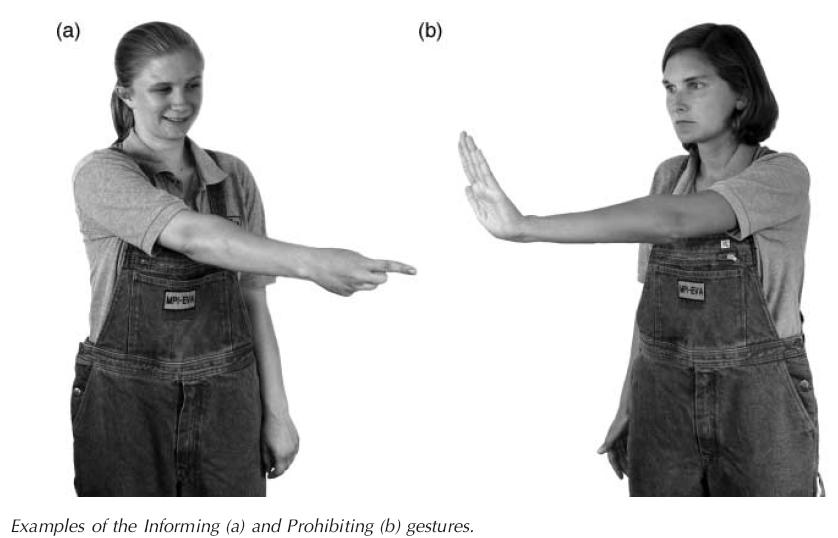
At 14 months of age for example, human children are able to successfully pass an object-choice task. In this task, children are presented with two upside-down buckets, one of which contains a toy, and the experimenter points toward the bucket where the toy is hidden. The child then turns to the right bucket and retrieves the toy. Although this task may appear simple, it is remarkable that chimpanzees fail it. In contrast to children, they fail to see the pointing gesture as a relevant cooperative signal within a shared attentional frame. Instead chimpanzees seem to think something along the lines of: “‘A bucket. So what? Now where’s the food?’ They do not understand that the pointing is intended to be ‘relevant’ to the searching as a shared activity (see Sperber & Wilson, 1986)” (Tomasello & Carpenter 2007: 122).


But this result is reversed in chimpanzees when instead of pointing cooperatively towards the bucket, the experimenter makes a prohibiting gesture by holding her arm out towards the correct container with her palm out, says something like “Don’t take this one” in a firm manner and then leaves the room. In this competitive context chimpanzees can successfully infer where the hidden reward. What is equally interesting is that 24 month old children do not retrieve the hidden toy possibly because they were better at cognitive control than 18 month old children and chimpanzees and were aware of the social and communicative conventions of the prohibiting action (Hermann & Tomasello 2006, see e.g. Miller et al. 2002, Tomasello 2008: 208ff. ).


Understanding Shared Experience

At the age they are able to solve a simple informative object-choice, infants also can keep track of who is familiar with some toy and who is not through shared experience.


In an experiment involving three toys and two experimenters, the first experimenter and the infant played together with two of the toys, then the first experimenter left the room. After that, the second exph the experimenter and the infant played with all three of the toys, but with two of them in a normal fashion and with one of them in a very excited manner. When the first experimenter then came back in ambiguously asked for “it” infants reliably gave them the toy they had an excited shared experience with. Control conditions clearly showed that the infants knew “which of these objects “we”—and not just me or you alone—had experienced in a special way in the immediate past: (Moll et al. 2008: 98). A linguistic experiment in which a mother played with three toys together with her child then left the room, and the child then played with a fourth novel toy together with an experimenter had similar results. When the mother came back and looked at the four toys and excitedly exclaimed “Oh, a modi, a modi!” the child successfully learned this as the word for the fourth novel object drawing on their experience of sharing common ground with the mother in respect to the first three toys, but not with the new toy (Akhtar et al. 1996).

Understanding Joint Commitments

In general, human children and infants seem to be much more interested in cooperation, sharing, and committing themselves to a shared goal and a shared experiential perspectives than other primates. In specific contexts chimpanzees exhibit joint, co-operative, coordinated hunting for small monkeys (Boesch & Boesch 1989), and human-raised enculturated chimpanzees successfully solve co-operative problem-solving tasks in which food could be retrieved only together with a non-competitive, familiar human adult both when it required parallel and complementary roles. When it comes to social games, however, such as one person rolling a ball down and another one catching it with a can (complementary), or making a wooden block jump on a trampoline (parallel), the chimpanzees showed no interested and played with single parts of the game set-up for themselves. 18 to 24 month-old human children on the other hand successfully took part in both the co-operative problem-solving tasks as well as the social games. What is more, in contrast to the chimpanzees the children actively tried to reengage the adult when he ceased doing his part of the co-operative activity in both problem-solving and social contexts. Children thus explicitly displayed skills of shared intentionality by being jointly committed to a shared goal with shared intentions. These skills can also be seen in the manifesting conversational and linguistic skills of children around that time (Tomasello 2003).

Pointing in Human Children and Chimpanzees


The shared intentionality infrastructure is also already present in communicative power of pantomiming and informative pointing just for the sake of sharing attention and sharing information which infants acquire around their first birthdays (Tomasello 2008: 111). These behaviours even include references to absent object or events such as something that is going on outside, happened in the past or will happen again in the future, a cup that is empty and should be filled, to something that is hidden or not present at the moment (Tomasello 2008: 116f.). Chimpanzee’s on the other hand, practically rarely point in natural contexts, and captive chimpanzees only do so when requesting something, using the human as a “social tool” (Tomasello 2006). A similar imperative behaviour has recently been observed in the wild: during grooming, chimpanzees sometimes point to a specific part of their body where they want to be scratched. (Pika & Mitani 2009). These "directed scratches" however, are also imperative in nature and not declarative.

In contrast, 12 to 18 month-olds also point co-operatively to inform others of the location of an object they are looking for. (Liszkowski et al. 2006 : 173). Generally humans infants and children have a natural tendency to be extremely cooperative in a variety of task and help others solve their problems
“even when the other is a stranger and they receive no benefit at all. However, our nearest primate relatives show some skills and motivations in this direction as well, and this suggests that the common ancestor to chimpanzees and humans already possessed some tendency to help before humans began down their unique path of hypercooperativeness.” (Warneken & Tomasello 2006: 1302 )

The evidence presented here strongly suggest that it indeed seems that social intelligence was a driving factor and the crucial foundation for what makes us unique.

But in addition, it seems that in the human lineage the “Machiavellian Intelligence Hypothesis,”, which sees social competition as the main causal factor for primate, including human brain evolution (Byrne & Whiten 1988, Humphrey 1976), does not apply across the board. Instead, it seems that the unique aspects of human cognition were driven, and are maybe even constituted by, collaboration, cooperation and the natural motivation to share experiences, intentions and perspectives, which then led to the advances in culture, technology, and higher-order cognition we see today (Moll & Tomasello 2007).

References:

Akhtar, N., Carpenter, M., & Tomasello, M. (1996). The role of discourse novelty in early word learning. Child Development, 67, 635-45.

Boesch, C. & Boesch, H. (1989): Hunting behavior of wild chimpanzees in the Taï-National Park. American Journal of Physical Anthropology 78(4), 547-573.

Byrne, R. & Whiten, A. (eds) (1988) Machiavellian intelligence: social expertise and the evolution of intellect in monkeys, apes and humans. Oxford, UK: Oxford University Press

Hare, Brian, and Michael Tomasello. (2005). Human-like social skills in dogs? Trends in Cognitive Science, 9, 439-444.

Herrmann, Esther. & Michael Tomasello, (2006). Apes' and children's understanding of cooperative and competitive motives in a communicative situation. Developmental Science, 9, 518-529

Humphrey, N. (1976) The social function of intellect. In Growing points in ethology (eds P. P. G. Bateson & R. A. Hinde), pp. 303–317. Cambridge, UK: Cambridge University Press.

Hurford, James M. (2007): The Origins of Meaning: Language in the Light of Evolution. Oxford: Oxford University Press.

Sperber, Dan and Deirdre Wilson (1995): Relevance: Communication and Cognition. Second Edition. Malden et al.: Blackwell.

Miller, Earl K., David J. Freedman and Jonathan D. Wallis (2002.) “The Prefrontal Cortex: Categories, Concepts and Cognition.” In: Phil. Trans. R. Soc. Lond. B 357: 1123–1136

Moll, Henrike and Michael Tomasello (2006): Level 1 Perspective-Taking at 24 Months of Age. British Journal of Developmental Psychology 24, 603–613

Liszkowski, U., Carpenter, M., Striano, T., & Tomasello, M. (2006). Twelve- and 18-month-olds point to provide information for others. Journal of Cognition and Development 7: 173-187.

Moll, Henrike, & Michael Tomasello. (2007) Co-operation and human cognition: The Vygotskian intelligence hypothesis. Philosophical Transactions of the Royal Society 362: 639-648.

Moll, Henrike., Richter, N., Carpenter, M., & Tomasello, M. (2008). Fourteen-month-olds know what ‘we’ have shared in a special way. Infancy, 13(1), 90-101

Tomasello, Michael (2003): Constructing A Language. A Usage-Based Approach. Cambridge, Massachusetts; London, England: Harvard University Press.

Tomasello, Michael (2008): The Origins of Human Communication. Cambridge, MA; London, England: MIT Press.

Tomasello, Michael and Malinda Carpenter (2007): “Shared Intentionality.” In: Developmental Science 10.1, 121-125.

Tomasello, Michael, Malinda Carpenter, Josep Call, Tanya Behne, and Henrike Moll (2005): Understanding and Sharing Intentions: The Origins of Cultural Cognition. In: Behavioral and Brain Sciences 28:5, 675–691.

Warneken, Felix. & Michael Tomasello, (2006). Altruistic helping in human infants and young chimpanzees. Science, 31, 1301 - 1303.

Thursday, June 18, 2009

Studying the Evolution of Cognition and Language: Are We Wasting Our Time? (Part 2)

In my last post I discussed some of the criticisms faced by people interested in the evolution of cognition.
One of the harshest critics is Richard Lewontin, who, at the end of his article "The Evolution of Cognition: questions we will never answer", advises his readers to “
to give up the childish notion that everything that is interesting about nature can be understood. History, and evolution is a form of history, simply does not leave suffcient traces, especially when it is the forces that are at issue. Form and even behavior may leave fossil remains, but forces like natural selection do not. It might be interesting to know how cognition (whatever that is) arose and spread and changed, but we cannot know. Tough luck.. (Lewontin, 1998: 130).”
But what leads Lewontin to conclude his essay in such as pessimistic and definitive manner?
According to Lewontin, there are three main strains of evolutionary explanations. And with each strain there are problems with evolutionary inquiries into cognition.

Historical Explanations
Firstly, there is a strain that explains the patterns of similarities and differences between animals through historical relatedness. Humans, for example, are more similar to and share more traits with chimpanzees than with lemurs because the human/chimpanzee lineages split some 5-7 million years ago and the lemur/human lineage split some 78 million years ago.

Functional Explanations
Secondly, there is a strain that tries to explain these patterns by looking at the functions they perform and the adaptive advantage they may have. The bodily similarities of sharks, dolphins, seals, and penguins for example can be explained by the fact that their bodies are adapted to swimming in the sea. Similarly, the differences between closely related species can be explained by adaptations to different environments. The differences between cows, goats, and deer, for example, only arose in the last 10 million years due to the different environments they had to adapt to. (Lewontin 1998: 116).

Problems for Studying the Evolution of Cognition
This is of course a problem for studying the evolution of cognition. Chimpanzees are the closest relatives that still exist but we and them may both have diverged so far from our ancestors that studying the cognitive differences between us may not really give us an insight into much human evolution. Indeed, there even is a study claiming “
more genes underwent positive selection in chimpanzee evolution than in human evolution.” (Bakewell et al. 2007).
Overall,
“Humans and chimpanzees are nevertheless very similar in their proteins, on the average, but vastly different in the sizes of their brains and their ability to write books about each other.” (Lewontin, 1998: 117).
But here is a point where I disagree with Lewontin: the research shown earlier indeed indicates that there probably was not a large amount of changes in brain-related genes that led to human cognition:
“This conclusion, however, does not preclude the possibility that substantial accelerations occurred in the evolution of a few nervous system genes during human origins. Indeed, several such examples are known, including genes that control brain size and speech development. (Shi et al. 2006).
And indeed, a recent article based on assumptions similar to that of these researchers and Lewontin, by Derek Penn and his colleagues, (2008) doesn’t see things so negatively as Lewontin but instead sees these considerations as offering a great chance.

If there really is “profound functional discontinuity between human and nonhuman minds” we can ask if there is a core ability that is responsible for it.
For Penn et al. psychological, comparative and developmental studies point towards the conclusion that this cognitive cap
“is largely due to the degree to which human and nonhuman minds are able to approximate the higher-order, systematic, relational capabilities of a physical symbol system.”
Sara Shettleworth (2009), in her critique of Bolhuis & Wynne’s (2009) arguments which are quite similar to that of Lewontin, agrees that
“There is evidence from behavioural studies that many of humans' mental powers are shared by other animals, including simple forms of learning, memory and categorization, and the elements of social, spatial and numerical cognition.
Only against this background does it make sense to propose, as some have, that there is a distinct small set of mental powers that is unique to humans […].”
Other researchers also defend the view that, contrary to Lewontin, we can learn a lot about the evolution of primate and human cognition by comparing different extant species. Jonathan Kenneth Burns (2004), for example, directly attacks Lewontin's arguments in an article on the evolution of Schizophrenia by stating that primatologist Richard Byrne
“has listed the establishing of a reliable pattern of descent as one part of a methodology for inferring the history of primate cognition (Byrne 2000). Many authors have confirmed the close evolutionary relationship between simian and ape species and modern Homo sapiens, with strong data from comparative psychology, molecular biology, and physical anthropology. Thus, cladistic analysis provides us with living relative species with which we can test the hypothesis that there is a heritable variation for social cognition that increases fitness.“ (Burns 2004: 868)
Evolutionary Constraints
But back to Lewontin’s article. The third strain of evolutionary theory he mentions is the one focusing on developmental and physiological constraints in the evolution and development of organisms. In the billion years of vertebrate evolution, for example, no organism ever developed more than four limbs.
Equally, mammals that went back into the sea and became whales and seals, the turned their limbs into flippers and flukes, but still retained their basic mammalian skeletal architecture.
This probably means that there are basic biological constraints because the available material regulates which evolutionary changes are possible, although the functions and activities of organisms and their parts may change quite dramatically over evolutionary time.
It also implies that
“when new functions arise in evolutiom, they often do so through a process of recruiting previously existing organs or physiological activities.” (Lewontin 1998: 117).
But If a trait is unique to one species it may be that we can’t really find any direct precursors and that it thus has no real “observable evolutionary history.”
What is more, we can’t be sure if a similar trait in other species it is far from clear if
"we are dealing with the same trait in the genetic, anatomical, and physiological sense.” (Lewontin 1998).
Platforms for the evolution of human cognition
I would argue however, that studies that show that similar cognitive activities which activate and rely on similar neural systems are a strong candidate for homologous platforms for human cognitive evolution. In fact, we now know that there are strong neural similarities between aspects of the macaque conceptual system and the human once (Gil-da-Costa et al. 2004).
With research like this we can thus probe into the “common architecture” that “underlies the conceptual systems of different species”, and ask how “additional systems” may have extended “human conceptual abilities significantly” (Barsalou 2005).
We also know now that “Communicative Signaling Activates ‘Broca’s’ Homolog in Chimpanzees,” and recent comparative neuroimaging studies have given new and important insights into the evolution of specialized language areas in human evolution. (for a great summary see this post).

Concluding Remarks
These examples lead me to think that we can learn a lot about the evolution of human cognition and language if we draw together the massive amount of data on the subject from all the different disciplines in a coherent and sensible manner. We simply have much more data to work with than at the time Lewontin voices his criticisms. Studying the evolution of cognition is – or has become – more than a ‘Paleofantasy’ in which we simply tell stories because we don’t know enough. Quite to the contrary – often it is the incredible wealth of data from different disciplines that presents the biggest problem.
Sverker Johansson's (2005) gargantuan collection of data relevant to the study of language evolution bears testament to this. The Study of language evolution, after it has moved beyond its ‘adaptationist’ beginnings in the early to mid-nineties – which Lewontin rightly criticized in some respects – is still a developing and growing field and I certainly agree with Willem Zuidema (2005) who states that
“Only when we have precise scenarios of the evolution of language and worked out ways to test empirically the plausibility of one scenario against another, can we conclude . if that turns out to be the case that there are too many alternative scenarios consistent with the available data. In my view, we have certainly not reached this stage yet.”


I hope I can wrap up my discussion of Lewontin's article next week.

References:

Bakewell,Margaret A., Peng Shi, and Jianzhi Zhang (2007:) More genes underwent positive selection in chimpanzee evolution than in human evolution. PNAS 104: 7489-7494.

Barsalou, Lawrence W. 2005. “Continuity of the conceptual system across species.” Trends in Cognitive Science 9.7: 309-311.

Bolhuis, Johan and Clive D. L. Wynne (2009):Can evolution explain how minds work?' Nature 458: 832–833.

Burns, Jonathan Kenneth. (2004) An evolutionary theory of schizophrenia: Cortical connectivity, metarepresentation, and the social brain. Behavioral and Brain Sciences
27(6):831–55; Discussion, 855–85.

Byrne, Richard W.(2000) Evolution of primate cognition. Cognitive Science 24(3):543–70

Gil-da-Costa, Ricardo, Allen Braun, Marco Lopes, Marc D. Hauser, Richard E. Carson, Peter Herscovitch and Alex Martin. 2004. “Toward an evolutionary perspective on conceptual representation: Species-specific calls activate visual and affective processing systems in the macaque.” PNAS 101.50: 17516–17521.

Johansson, Sverker (2005): Origins of Language: Constraints on Hypotheses. Amsterdam: Benjamins.

Lewontin, R. C. (1998) The evolution of cognition: Questions we will never answer. In D. Scarborough and S. Sternberg, editors, An invitation to cognitive science, Volume 4: Methods, models, and conceptual issues. Cambridge, MA: MIT Press

Shettleworth, Sara J. (2009). Cognition: theories of mind in animals and humans. In: Nature 459: 506.

Shi, Pen Margaret A. Bakewell and Jianzhi Zhang(2006):Did brain-specific genes evolve faster in humans than in chimpanzees? Trends in Genetics 22: 608-613.

Monday, June 15, 2009

Studying the Evolution of Cognition and Language: Are We Wasting Our Time? (Part 1)

This is my penultimate post in my short series on human uniqueness (1, 2, 3).

In a recent article in nature, Johan J. Bolhuis and Clive D. L. Wynne asked “Can evolution explain how minds work?” (subscription needed) and were of the opinion that there are severe problems with comparative paradigms. They pointed out major problems with evolutionary interpretations of cognitive traits. In their view, this research was fraught with anthropocentrism, e.g. it was mostly focused on humans or seen from a human perspective, and it doesn’t take into account the problem of convergent evolution:

“Different species may have arrived at similar solutions to cognitive problems because they have experienced similar selection pressures, not because they are closely related. In other words, evolutionary convergence may be more important than common descent in accounting for similar cognitive outcomes in different animal groups” (Bolhuis & Wynne 2009).


In addition, we don’t know which selective pressures our ancestors faced in their environment. Cognitive traits also leave little to no traces in the fossil record. This means that we mainly have to guess which cognitive traits may have evolved in response to some presumed selection pressures.


Bolhuis and Wynne also hold that comparative researchers have “naïve evolutionary presuppositions” and hold that

“As long as researchers focus on identifying human-like behaviour in other animals, the job of classifying the cognition of different species will be forever tied up in thickets of arbitrary nomenclature that will not advance our understanding of the mechanisms of cognition.” (Bolhuis & Wynne 2009).


This argument is of course not new and can be found – in an even stronger form and on a more general level – in the critical writings of Noam Chomsky, Stephen Jay Gould, and maybe most vocally, Richard Lewontin. Lewontin even goes so far as to say that the only thing we know about the evolution of human cognition is precisely that it evolved. That’s it. (Lewontin 1998: 108). This is especially so with complicated cognitive traits like linguistic competence.


We don’t even know in how far language is an innate genetically specified ability and in how far it is only a by-product of other evolutionary changes and is shaped and specified by culture. What’s more, we can’t possibly know how hereditary mechanisms (both genetic and cultural) acted in our remote ancestor, and we don’t know anything about the survival advantage these presumed mechanisms may have had in the past. Lewontin draws the conclusion that “reconstructions of the evolutionary history and the causal mechanisms of linguistic competence […] are nothing more than a mixture of pure speculation and inventive stories.” (Lewontin 1998: 111).

He explicitly directs his criticism at proposals like that of Pinker & Bloom (1990) (see also this post) who argued that natural selection is the only force that can explain the evolution of such a ‘complex adaptive’ trait like language. But we can’t show how natural selection might have been at work in each of the unknown stages that were necessary for language to evolve. Consequently, Pinker & Bloom’s argument is flawed.


I think Lewontin’s argument applies to some of the sweeping ‘adaptationist’ evolutionary approaches to language and cognition. But I don’t think his 1998 critique really captures the state of the research today or even earlier. In the 2003 anthology ‘Language Evolution’ (Kirby & Christiansen 2003, see also this post) which pretty much presented the state of the field there were many researchers who had a substantial amount to say about the evolution of language without falling into the theoretical pitfalls Lewontin warned about. At the end of his article Michael Tomasello, for example, cautions that “I am afraid that I have no real evolutionary fairy tale with which to conclude.” But he still has to clarify what valuable implications his research has for a general account of the evolution of language and cognition and is able to spell out some of the cognitive mechanisms which had to evolve and in how far culture has been an important aspect in this respect (Tomasello 2003: 108f.). Similarly, Marc Hauser and W. Tecumseh Fitch voice similar criticism to that of Lewontin and Chomsky (which is not very surprising given that they co-authored two papers with the latter). However, they hold that the “comparative approach to language has been and will continue to be a powerful approach to understand both the evolution and current function of the language faculty.” (Hauser & Fitch 2003: 159). I completely agree with them, especially if we throw developmental science into the mix. By looking at non-human primates we are able to “isolate and study those components of the language faculty inherited from our non-human ancestors” (Hauser & Fitch 2002: 159). What is more, comparative research can also give us insight into possible advantages and selection pressures that led to the evolution of features. If we find similar traits and neural subsystems in other primates it is reasonable to assume that these are homologous and due to our shared evolutionary history. If on the other hand, other primates don’t have these traits but other species, e.g. songbirds, jays, parrots or deer, have them, they may be analogous and due to similar environmental or social selection pressures. If we carefully compare many different species across different taxa we get an increasingly better picture of the evolution of cognition in humans and other species.

But a broad survey of the field shows that this is already done as Sara Shettleworth (2009a) points out. Consequently, Bolhuis and Wynne’s criticism falls apart if we actually look at the field they are criticising and it is more as if they are flogging a dead horse (2009b). But we can see that Tomasello, Hauser, Fitch, Bolhuis, Wynne and Shettleworth all think that comparative cognition can give us important insights into the evolution of the organisms they study and compare. But it has to be done carefully and critically and within a throroughly worked out theoretical and methodological framework. In light of this, much of Lewontin’s criticisms seem to be misguided or at least do not really apply anymore. But does this really mean that there are no real general problems with evolutionary inquiries into the evolution of cognition?

In my next post I will address the additional criticisms Lewontin launches at the study of the evolution of cognition.


References:

Bolhuis, Johan and Clive D. L. Wynne (2009):Can evolution explain how minds work?' Nature 458: 832–833.

Hauser, M. D. & Fitch, W. T. (2003). What are the uniquely human components of the language faculty? In: Language Evolution: The State of the Art. Ed. by Christensen, M. & S. Kirby) pp. 158-181. Oxford: Oxford Unviersity Press.

Normal 0 21 Lewontin, R. C. (1998) The evolution of cognition: Questions we will never answer. In D. Scarborough and S. Sternberg, editors, An invitation to cognitive science, Volume 4: Methods, models, and conceptual issues. Cambridge, MA: MIT Press

Pinker, Steven & Paul Bloom (1990): “Natural Language and Natural Selection.” In: Behavioral and Brain Sciences 13.4: 707-726.

Shettleworth, S. J. (2009a). The evolution of comparative cognition: Is the snark still a boojum? In: Behavioural Processes , 80, 210-217.

Shettleworth, Sara J. (2009b). Cognition: theories of mind in animals and humans. In: Nature 459: 506.

Tomasello, M. (2003). On the different origins of symbols and grammar. In Language Evolution: The State of the Art. Ed by. M. Christiansen & S. Kirby. Oxford: Oxford University Press.

Friday, May 22, 2009

An Evolutionary Perspective on the Human Brain

This term I wrote an essay on the topic of human uniqueness from an evolutionary perspective. As I drew on research that is also relevant to this blog, (and to some extent has already been covered here). I'll post some of it here.
In this post I'll have a short look at the human brain from a neuroscientific, a comparative, and an evolutionary perspective:

Human Evolution

We are evolved primates. (As are all other primates of course. So maybe it is better to say that we, like all other primates, are evolved beings with a unique set of specializations, adaptations and features. )

In our lineage, we share a common ancestor with orangutans (about 15 million years ago (mya)), gorillas (about 10mya), and most recently, chimpanzees and bonobos (5 to 7 mya). We not only share a significant amount of DNA with our primate cousins, but also major anatomical features (Gazzaniga 2008: 51f., Lewinn 2005: 61) These include, for example, our basic skeletal anatomy, our facial muscles, or our fingernails (Lewin 2005: 218ff.).


What most distinguishes us as humans on an anatomical level are our bizarre hair distribution, our upright posture and the skeletal modifications necessary for it, including a propensity for endurance running, our opposable thumbs, fat deposits that are unusually extensive (Preuss 2004: 5), and an intestinal tract only 60% the size expected of primates our size (Gibbons 2007: 1558).


Finally, there is also a distinguishing feature that is a much more remarkable violation of expectations – a brain three times the size expected of a primate our size. This is all the more interesting as primates are already twice as encephalized as other mammals (Lewin 2005: 217). A direct comparison shows this difference in numbers: Whereas human brains have an average volume of 1251.8 cubic centimetres and weigh about 1300 gram, the brains of the other great apes only have an average volume of 316.7 cubic centimetres and weigh between 350-500 gram (Rilling 2006: 66, Preuss 2004: 8). In a human brain, there are approximately a hundred billion neurons, each of which is connected to about one thousand other neurons, comprising about one hundred trillion synaptic connections (Gazzaniga 2008: 291). If you would count all the connections in the napkin-sized cortex alone, you would be finished after 32 million years (Edelman 1992: 17).


Expensive Tissue

The human brain is also extremely “expensive tissue” (Aiello & Wheeler 1995): Although it only accounts for 2% of an adult’s body weight, it accounts for 20-25% of an adult’s resting oxygen and energy intake (Attwell & Laughlin 2001: 1143). In early life, the brain even makes up for up 60-70% of the body’s total energy requirements. A chimpanzee’s brain, in comparison, only consumes about 8-9% of its resting metabolism (Aiello & Wells 2002: 330). The human brain’s energy demands are about 8 to 10 times higher than those of skeletal muscles (Dunbar & Shultz 2007: 1344), and, in terms of energy consumption, it is equal to the rate of energy consumed by leg muscles of a marathon runner when running (Attwell & Laughlin 2001: 1143). In all, its consumption rate is only topped by the energy intake of the heart. (Dunbar & Shultz 2007: 1344).

Consequently, if we want to understand the evolutionary trajectory that led to human cognition there is the problem that “because the cost of maintaining a large brain is so great, it is intrinsically unlikely that large brains will evolve merely because they can. Large brains will evolve only when the selection factor in their favour is sufficient to overcome the steep cost gradient“ (Dunbar 1998: 179). We have to come up with a strong enough selection pressure operative in the Pleistocene environment of evolutionary adaptedness that would have allowed such “expensive tissue” to evolve (Bickerton 2009: 165f.).


What About the Brain is Uniquely Human?


If we look to the brain for possible hints, we first find that presently, there is “no good evidence that humans do, in fact, possess uniquely human cortical areas” (although the jury is still out) (Preuss 2004: 9). In addition, we find that there are functions specific to humans which are represented in areas homologous to areas of other primates. Instead, it seems that in the course of human evolution some of the areas of the brain expanded disproportionally, “especially higher-order cortical areas, including the prefrontal cortex” (Preuss 2004: 9, Deacon 1998: 435-438). This means that humans do not only think in a better way, but that they think differently (Preuss 2004: 7). The expansion and apparent specializations of only certain kinds of neuronal areas could indicate a qualitative shift in neuronal activity brought about by re-organization of existing features, leading to a wholly different style of cognition (Deacon 1998: 435-438 Rilling 2006: 75).

This scenario squares well with what we know about the way evolution works, namely that it always has to work with the raw materials that are available, and constantly co-opts and tinkers with existing structures, at times producing haphazard, cobbled-together, but functional results (Gould & Lewontin 1979, Gould & Vrba 1982). Given the relatively short time span for the evolution of the “most complex structure in the universe, we have to acknowledge how preciously little time the evolutionary process had for ‘debugging.’ It could well be that make the human mind so unique is that it is a imperfect ‘Kluge:’ a clumsy or inelegant – yet surprisingly effective – solution to a problem,” like the Apollo 13 CO2 filter or an on-the-spot invention by MacGyver (Marcus 2008: 3f.). It may thus well turn out that what we think makes us so special is a mental “oddity of our species’ way of understanding” the world around us (Povinelli & Vonk 2003: 160). It is reasonable then to assume that human cognition did not just simply get better across the board, but that instead we owe our unique style of thinking to quite specific specializations of the human mind.

With this in mind, we can now ask the question how these neurological differences must translate into psychological differences. But this is where the problem starts: Which features really distinguish us as humans and which are more derivative than others? A true candidate for what got uniquely human cognition off the ground has to pass this test and solve the problem how such “expensive tissue” could evolve in the first place.


References:

Aiello L.C. and P. Wheeler 1995. ”The expensive tissue hypothesis: the brain and the digestive system in human and primate evolution.” Current Anthropology 36:199–221


Aiello, Leslie C. and Jonathan C. K. Wells (2002): “Energetics and the Evolution of the Genus Homo.” In: Annual Review of Anthropology 31:323–38.


Attwell, David and Simon B. Laughlin. (2001.) “An Energy Budget for Signaling in the Grey Matter of the Brain.” Journal of Cerebral Blood Flow and Metabolism 21:1133–1145.


Bickerton, Derek (2009): Adams Tongue: How Humans Made Language. How Language Made Humans. New York: Hill and Wang.


Deacon, Terrence William (1997). The Symbolic Species. The Co-evolution of Language and the Brain. New York / London: W.W. Norton.


Dunbar, Robin I.M. (1998)“The Social Brain Hypothesis” Evolutionary Anthropology 6: 178-190.


Dunbar, R. I. M. and Susanne Shultz. (2007)“Evolution in the Social Brain” Science 317: 1344-1347


Edelman, Gerald Maurice (1992) Bright and Brilliant Fire: On the Matters of the Mind. New York: Basic Books


Gazzaniga, Michael S. (2008): Human: The Science of What Makes us Unique. New York: Harper-Collins.

Gibbons, Ann. (2007) “Food for Thought.” Science 316. 1558-1560.


Gould, Stephen Jay and Richard Lewontin (1979). "The spandrels of San Marco and the Panglossian paradigm: a critique of the adaptationist programme". Proclamations of the Royal. Society of London B: Biological Sciences 205 (1161): 581–98.


Gould, Stephen Jay, and Elizabeth S. Vrba (1982), "Exaptation — a missing term in the science of form," Paleobiology 8 (1): 4–15.


Lewin, Roger (2005): Human Evolution: An Illustrated Introduction. Oxford: Blackwell.


Marcus, Gary (2008): Kluge: The Haphazard Evolution of the Human Mind. London: Faber and Faber.


Povinelli, Daniel .J. and Jennifer Vonk. (2003) Chimpanzee minds: Suspiciously human? Trends in Cognitive Sciences, 7.4, 157–160.


Preuss Todd M. (2004): What is it like to be a human? In: Gazzaniga MS, editor. The Cognitive Neurosciences III, Third Edition. Cambridge, MA: MIT Press: 5-22


Rilling, James K. (2006.) “Human and NonHuman Primate Brains: Are They Allometrically Scaled Versions of the Same Design?” In: Evolutionary Anthropology 15: 67-77

Wednesday, February 11, 2009

Preparing for Darwin's Birthday: Celebrations & Myths

Tomorrow is Darwin's 200th Birthday and all over the blogosphere and in magazines, TV etc. there are a lot of interesting things on Darwin, "Darwinism", and evolutionary biology.

Some Highlights:

Ed Yong of Not Exaxtly Rocket Sciene has started a 8-posts series on evolutionary research to celebrate Darwin's bicentennial. The topics covered so fare are

Posts on evolutionary arms races, human evolution, virus evolution, and co-evolution and horizontal gene transfer are still to follow.

John Wilkins of Evolving Thoughts will try to clarify some of the oft-repeated myths about Darwin and his ideas.
These will include:

  • Darwin did not believe in the reality of species
  • Darwin did not explain the origin of species in The Origin of Species
  • Darwin was actually a Lamarckian
  • Darwin was a gradualist
  • Darwin thought evolution relied on accidents and chance
  • Darwin thought everything was due to natural selection
  • Darwin thought that Australian aborigines were closer to apes than to Europeans
  • Darwin was a social Darwinian
There are some things in there I thought to be true. But otheres are pretty obvious. Just for fun I'll quicky adress two of these myths (although John Wilkins will have a lot mor to say about them, of course), and add another one that's not a myth but just a wrong assumption.

Myth: Darwin thought everything was due to natural selection
Wrong. In The Origin of Species he clarifies that:

"I am convinced that Natural Selection has been the main but not exclusive means of modification. (69)"

In this book he also introduced the factor of sexual selection, i.e. the fact that evolutionary change can also be influenced by females choosing mates with certain traits.
In his 1871 book adressing human evolution, The Descent of Man, Darwin tried to explain the evolution of many of the mental powers of humans in terms of sexual selection.

It is also important to note that in this book Darwin also pointed out that:
"Important as the struggle for existence has been and still is yet as far as the highest part of our nature is concerned there are other agencies more important"
This also brings us to the next Myth

Myth: Darwin was a Social Darwinist
No. People who advocated these ideas of laissez faire capitalism were Herbert Spencer, John Fiske and William Graham Sumner (although it is debated how much he really was a Social Darwinist). They came up with this ideads after reading Darwin, but more often, (as in the case of John Fiske), after reading Herbert Spencer interpreting Darwin in his own way.

Also, Darwin is sometimes quoted a promoting eugenics with this statement:
"It is surprising how soon a want of care, or care wrongly directed, leads to the degeneration of a domestic race; but excepting in the case of man himself, hardly any one is so ignorant as to allow his worst animals to breed."
But as we have seen above, for humans there are other agencies more important and this is why he continues:
"If we were to intentionally neglect the weak and the helpless, it could only be for a contingent benefit, with overwhelming present evil. Hence we must bear without complaining the undoubtedly bad effects of the weak surviving and propagating their kind"

Another popular misconception, not really a myth, is that Darwin coined the term "survival of the fittest." But in fact the term was coined by Herbert Spencer (who had already proposed his own concept of evolution in 1855) after reading Darwin. Darwin then used the term in later versions.

The New Scientist also has a page up on 24 popular misconceptions about evolutionary theory

There's also another reason to celebrate: Carl Zimmer of the Loom has announced that he's writing a textbook for non-biology-majors and the general reader called The Tangled Bank: An Introduction to Evolution and it's going to come out this year in August. Woohoo!