Sunday, June 13, 2010

Cognigrams

On Thursday I went to a talk by Miriam Noel Haidle, who talked about tool use in human and non-human animals. Haidle is part of the research project "The role of culture in early expansions of humans," which looks extremely interesting.
In her talk, Haidle introduced the idea of "cognigrams," which code the cognitive operations necessary for performing a complex task with multiple steps such as tool use. What is most interesting is that you can create cognigrams for the tool-using behaviour of humans, other tool using animals, and pre-humans, and then compare their complexity and use this to asses their cognitive potential.

Here's the abstract of her most recent paper elaborating on this idea:

"Tool use is the main database to track down behavioral developments in the archaeological record and thus human evolution. Working-memory capacity and modern cognitive potential, however, are no simple and obvious characters in tool behavior. Coded in cognigrams, which allow a direct comparison, animal and human tool use can be examined for specific aspects of the working-memory capacity. Detailed studies of tool behavior of wasps, sea otters, bottlenose dolphins, and chimpanzees are presented and compared with the manufacture and use of Oldowan tools and Lower Paleolithic spears. Although this shows a wide range of problem-solution distances, problem solving in animals seems to be restricted to problem complexes for which a solution can be found in spatial and temporal vicinity. In human evolution, the complexity of tool behavior increases regarding the number of active foci managed at a time in an action, the number and diversity of operational steps in a problem-solution complex, and the spatial and temporal frame in which solutions are sought. The results suggest a gradual development of the different aspects of a complex capacity instead of a late introduction of a closed phenomenon with only different facets."

Haidle, Miriam Noël (2010) Working‐Memory Capacity and the Evolution of Modern Cognitive Potential. Current Anthropology 51:s1, S149-S166

Here are two of these 'cognigrams', one of a chimpanzee tool set which is used to extract termites, (Haidle 2010: S154) and one of the cognitive complexity needed to create the kind of 400,000 year-old spear found in Schöningen, Germany. (Haidle 2010: S156)




Wednesday, April 14, 2010

Edmund Blair Bolles Blogging about the 2010 Evolution of Language Conference


Over at Babel's Dawn Edmund Blair Bolles has started blogging on the 2010 Evolution of Language Conference in Utrecht, the Netherlands.

- his first critical discussion of Maggie Tallerman's talk defending the sense of a partly-language-specific innate 'language faculty' can be found here.

In her talk, Tallerman mentioned that some of Chomsky's recent ideas on 'third factor principles,' physical laws, and general cognitive principles playing a part in constituting language are actually quite similar to people who criticize generativism.

I had the same impression after attending a talk Noam Chomsky gave a few weeks ago in Mainz, Germany. In the Q&A section there he even spoke of the importance of social factors like 'Theory of Mind' in the evolution or rather the evolutionary transmission of language once the cognitive property of 'merge' had been externalized linguistically.

I'm really interested in what the other people at the conference will say about Tallerman's talk so I'll stay tuned.

Update:

Bolles' other posts on the conference, which are based on the slides the presenters sent to him in advance, can be found here:

- Terrence Deacon's talk

- Peter Gardenförs' talk

- Stephen Anderson's talk

- Morten Christiansen' talk

Monday, February 8, 2010

Biolinguistics, Cooperation, the Importance of Theory of Mind for Language - and Dinosaurs


Some interesting links:
  • The journal "Biolinguistics" now has a blog (here). On it they want to post "a variety of material pertaining to the field of biolinguistics." As of now there isn't very much content other than some information on conferences but I'll stay tuned.

  • On a related note, Julia Fischer of the Cognitive Ethology Laboratory at the German Primate Center in Göttingen, Germany has written a short review of Michael Tomasello's book "Why We Cooperate." I've written a short summary of the slim volume myself, but I seem to have msiplaced the document... Anyway, this review is by somebody who really knows the stuff and is quite enlightening.

  • Also, over at Babel's Dawn there is an interesting discussion of a paper by David Leavens and Tim Racine (abstract here) that questions whether it is really justified to attribute sophisticated psychological processes to preverbal infants in the way Michael Tomasello and many others do. Instead, they argue that learning and growing up in a human community play a much more important part that is normally acknowledged (first part here, second part here). Edmund Blair Bolles thinks that the argument has some merit but remains sceptical. In the comment section of his first post, the authors themselves weigh in.

  • Lastly, and not really relatedly, I really like this cartoon:
  • hat tip: Richard Beck


Tuesday, January 12, 2010

New York Times Article on the Evolution of Language

There's a nice New York Times story by Nicholas Wade called "Deciphering the chatter of monkeys" that deals with the evolution of language. As Edmund Blair Bolles points out, it misses many things that are important about the topic but still its a comparatively good and well-written popular article.

Be sure to check out Mark Liberman's short discussion of the article here. He writes that it is a "remarkably good article, in comparison to many that I've seen on similar topics," which may or may not be a real compliment :)

Hat tip: Babel's Dawn, Language Log

Tuesday, December 8, 2009

Combinatorial Structure in Monkey Vocalizations

Both John Hawks and Babel's Dawn link to an interesting article in the New York Times that reports on an as of yet unpublished paper by Klaus Zuberbühler and his colleagues on combinatorial (syntax-like) structure in the calls of Campbell's Monkeys:

"If the Zuberbühler team’s observations are correct, the Campbell’s monkeys can both vary the meaning of specific calls by adding suffixes and combine calls to generate a different meaning. Their call system, the researchers write, “may be the most complex example of ‘proto-syntax’ in animal communication known to date.”"

From Zuberbühler's previous work (e.g. Zuberbühler 2002, Zuberbühler 2006) it was already clear that some monkey species have very limited degree of flexibility in combining the vocalizations, but the fact that the combinatorics seem to be more complex than thought before seems quite interesting.

P.S.: Ed Yong also has a nice write-up

Saturday, November 28, 2009

Another Proof of Life & Links

I know it's been ages since I posted anything and one of my new years resolutions is definitely going to be to post regularly again, but this year it seems that I just don't find the time.
But a lot of really interesting stuff has happened and I'll just post some links that I found particularly interesting.

First of all, and although it's already old news, the papers on Ardipithecus Ramidus published in Science caused a lot of excitement. John Hawks has a very nice FAQ on the subject and Edmund Blair Bolles considers the implications these findings have for accounts of the evolution of language.

Chris of the Lousy Linguist nicely rebuts a very confused article claiming that according to new research using 'analytical language' automatically leads to healthier discussions between couples. In this post Chris also invents the great term "the Full Liberman" (see also this Language Log post) for debunking nonsensical articles about linguistic research findings.
He also reposted a nice piece on the great work by Simon Kirby and his colleagues at the Language Evolution and Computation Unit at Edinburgh University who try to 'grow' an artifical language in the lab in order to understand how language might have evolved.

So if you wanna know what's up with these strange fruit check out Chris' post (picture taken from the University of Edinburgh)

My favourite journal, the Behavioral and Brain Sciences, has also published a quite controversial article called "The myth of language universals: Language diversity and its importance for cognitive science." In this article, Nicholas Evans, a linguist at the Australian National University, and Stephen Levinson of The Max-Planck-Institute for Psycholinguistics in Nijmegen, the Netherlands, argue that the Chomskyan and Generative approach fails in light of the stunning diversity of the world's languages. They argue that there are no real meaningful universals that can be found in all of the world's 6,000 to 8,000 languages. Instead, there are only "significant recurrent patterns in organization," but these "are better explained as stable engineering solutions satisfying multiple design constraints, reflecting both cultural-historical factors and the constraints of human cognition" than by innate language-specific capacities.

The article is accompanied by some 20+ commentaries by quite illustrious figures in linguistics and cognitive science, who weigh in on both sides of the issue. The commentators include, for example: Mark Baker, William Croft, Adele Goldberg, Martin Haspelmath, Michael Tomasello (who, unsurprisingly, argues that "Universal Gramar is Dead"), Steven Pinker & Ray Jackendoff, Geoffrey Pullum, Paul Smolensky, Derek Penn, Daniel Povinelli & Keith Holyoak, and others.

Last but not least, there is also a very interesting article by Joseph Henrich et al. coming out in the Behavioral and Brain Sciences sometime in the future. It is in a similar vein as the one of Evans and Levinson and is titled "The weirdest people in the world?" The authors argue that people living in Western, Educated, Industrialized, Rich, and Democratic (WEIRD) societies differ quite a lot cognitively from the rest of the world and thus "are among the least representative populations one could find for generalizing about humans."
I'm not sure about the general claim but the paper definitely has the best opening paragraph of any scientific paper ever:

"In the tropical forests of New Guinea the Etoro believe that for a boy to achieve manhood he must ingest the semen of his elders. This is accomplished through ritualized rites of passage that require young male initiates to fellate a senior member (Herdt, 1984; Kelley, 1980). In contrast, the nearby Kaluli maintain that male initiation is only properly done by ritually delivering the semen through the initiate’s anus, not his mouth. The Etoro revile these Kaluli practices, finding them disgusting."

(Hat tip: Deric Bownds' Mindblog)

Wednesday, September 23, 2009

Links: God and Dead Salmon

I'm really sad that I just don't get around to post anything at the moment, but I'm currently recieving my practical training for my teacher's degree and it's quite a handful. I really hope to be able to blog again soon, but right now I just don't find the time.

But you should all check out Greg Downey's online version of his Presentation "‘Sympathy for Creationists, and Other Thoughts from a Sceptical Anthropologist,’" over at Neuroanthropology.net It has load of really cool and funny images and a lot of links as well

Downey's main point is that, although it is totally clear that Creationist arguments don't have any merit at all, "many ‘believers’ in evolutionary theory share some of the intellectual errors evidenced by Creationists. "
Downey argues that one of the main problems with evolutionary theory in general are our difficulties of conceptualizing and really grasping evolutionary processes and concepts properly. (This point is of course not new but it is still an important one to make - one nice proposal I think is the 'soap opera' view of evolution)


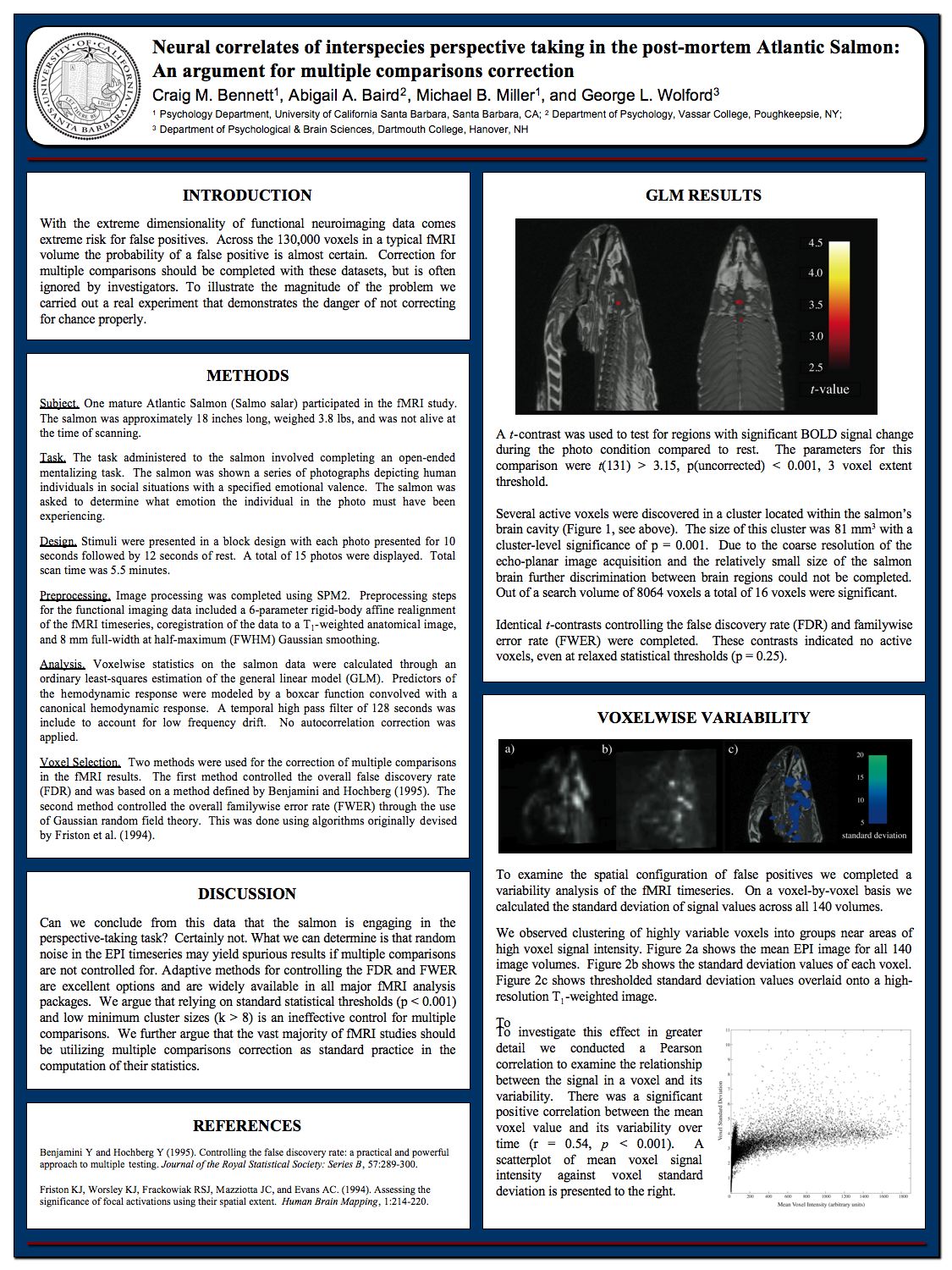
Another really entertaining and interesting topic are the many posts all over the blogosphere (e.g here and here) on an ingenious study that found neural activation for "emotional perspective-taking" in a brainscan of - wait for it - a dead atlantic salmon (for the poster, see here, some interesting comments by one of the authors of the study can be found here and here). The authors nevertheless try to make a serious point, namely that it is extremely important to find relaible methods that can control for and correct random noises and misleading correlations. Go check it out


P.S. Oh And I totally forgot: Edmund Blair Bolles is live-blogging like crazy from the "Ways to Protolanguage" conference that totally went under my radar.


His posts so far are:

Protolanguage builds on mimicry
Memes co-evolve
Simulation Suggests Steps to Speaking of the Unseen
Does the Recapitulation Principle Apply?
Protolanguage Was Symbolic
Five Ways to Investigate Speech Origins