Monday, November 15, 2010

Michael Tomasello - Why We Cooperate

cross-posted at Replicated Typo

In this post I will offer a short overview of some aspects of Michael

Tomasello’s latest book „Why We Cooperate,” which is based on his 2008 Tanner Lectures on Human Values.
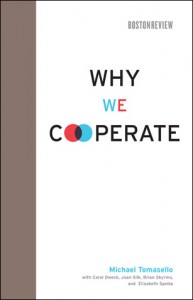
Tomasello deals with the question howcooperative behaviour and itssocio-cognitive foundations arise both in development and during theevolution of the human species. His short text is accompanied by four short commentaries by leading scholars who contributed in important ways to the theory of the evolution and ontogenetic development Tomasello espouses here. These are: psychologist Carol S. Dweck, anthropologist Joan B. Silk, philosopher Brian Skyrms and developmental psychologist Elizabeth Spelke.

In this post I only want to briefly summarize some of the key tenets of Tomasello’s book to offer an introduction to his work on cooperation, whose main impetus it is to have a closer look at the relatively simple and primal cooperative and interactive social behaviour that builds the foundation of human culture.

The Uniqueness of Human Culture

Tomasello points out that a lot of social animals can be said to have a culture insofar as the same animal species can live in slighty different habitats and show different behaviours (e.g. chimpanzees of different regions have different pant-hoots, many species have regionally differing techniques for obtaining food).
In this regard, human culture is only quantitatively different from that of, say, the other great apes. The difference here is that humans simply have to learn about more culture-specific behaviours and artefacts. The principle however, is the same.
But according to Tomasello, there are two aspects that also make human culture also qualitatively different from all others:

  1. human culture is cumulative. That is, artefacts and behavioural practices often become more complex over time. Every improvement or accepted changed will be transferred to the next generation and so forth.
  2. human culture is unique in that there are social institutions, which create and enforce culture norms and practices.

What underlies these two features “are a set of species-unique skills and motivations for cooperation.” (Tomasello 2009: XIII) on which Tomasello elaborates in the subsequent chapters.

Early Spelke

In the first chapter, “Born (and Bred) to Help”, Tomasello outlines how children come to be (or already are) cooperative so that they can take part in an co-establish human culture.
He advances a theory he dubs “Early Spelke, Later Dweck.”Research done by Tomasello and many others shows that by the time they are about one year old, infants already prove to be cooperative and helpful in many contexts. In addition, these tendencies seem not be taught but come naturally to them given sufficient interaction with a normal environment. (Hence ‘Early Spelke, referring to the work done by Harvard psychologist Elizabeth Spelke on innate or naturally emerging ‘core knowledge’).

Later Dweck
Later in development however, this picture becomes more complex: children come to be concerned about whether others will reciprocate and also about how they are judged by others in the group. They also gradually internalise cultural norms.
Up to now Tomasello has mostly described the initial starting point from which children refine their social behaviour and become truly cultural beings. More precisely, what happens is that children become less ‘indiscriminate’ in terms of who they behave altruistically towards, but become more discerning based on a variety of characteristics.

This phase could be described as the birth of the ‘public self’ which is concerned with ‘impression management.’ The child comes to realize that

“they are targets of the judgements of others who are using social norms as standards.” (Tomasello 2009: 31).

In other words, for the first time they develop a larger we- or group perspective, which is connected to the insight that this ‘we-ness’ is tied to certain social norms (‘They way we do things’).

Experiments show that by the age of three children actively follow social norms and also already participate in enforcing these norms.
If they grasp how a game works, for example, not only do the play it according to the rules, but they also correct others and object if they try to play the game differently.

Interestingly, they also use ‘normative declaratives’ like “One can’t do that” or “It doesn’t work like that,” when doing so.

Those findings contrast sharply with Jean Piaget’s influential view of how social norms are internalised. According to him, (and building on the work of Piaget, moral psychologist Lawrence Kohlberg), children follow social norms only because they fear punishment.

Instead, from and early age on children already seem to adopt some kind of ‘view from nowhere’ (Nagel 1970) and a “he is me” attitude of identification when interacting with others (see also Meltzoff 2005).

As Tomasello argues,

"without this added dimension of some kind of ‘we’ identity and rationality , it is impossible to explain take it upon themselves to actively enforce social norms on others from a third-party stance, especially those norms that are not based on cooperation but rather on constitutive rules that are, in an important sense, arbitrary" (Tomasello 2009: 39).

For Tomasello these processes form the basis of human cooperative behaviour, cultural transmission, social institutions and cultural practices.

References:

Meltzoff, Andrew N. (2005): Imitation and other minds: The "Like Me" hypothesis. In S. Hurley and N. Chater (Eds.), erspectives on Imitation: From Neuroscience to Social Science. Vol. 2, pp. 55-77). Cambridge, MA: MIT Press

Nagel, Thomas (1970) The possibility of altruism. Princeton, NJ: Princeton Unviersity Press.

Tomasello, Michael (2009): Why We Cooperate. Cambridge, MA/London, England: Boston Review.

Sunday, November 14, 2010

Cognitive Linguistics, Metaphor and Social Cognition

There's an interesting new article in the new issue of Psychological Bullettin arguing that our ability for metaphoric thinking (e.g. Lakoff & Johnson, 1980) plays a role in social cognition.
Here's the abstract (see here) :

"Social cognition is the scientific study of the cognitive events underlying social thought and attitudes. Currently, the field's prevailing theoretical perspectives are the traditional schema view and embodied cognition theories. Despite important differences, these perspectives share the seemingly uncontroversial notion that people interpret and evaluate a given social stimulus using knowledge about similar stimuli. However, research in cognitive linguistics (e.g., Lakoff & Johnson, 1980) suggests that people construe the world in large part through conceptual metaphors, which enable them to understand abstract concepts using knowledge of superficially dissimilar, typically more concrete concepts. Drawing on these perspectives, we propose that social cognition can and should be enriched by an explicit recognition that conceptual metaphor is a unique cognitive mechanism that shapes social thought and attitudes. To advance this metaphor-enriched perspective, we introduce the metaphoric transfer strategy as a means of empirically assessing whether metaphors influence social information processing in ways that are distinct from the operation of schemas alone. We then distinguish conceptual metaphor from embodied simulation—the mechanism posited by embodied cognition theories—and introduce the alternate source strategy as a means of empirically teasing apart these mechanisms. Throughout, we buttress our claims with empirical evidence of the influence of metaphors on a wide range of social psychological phenomena. We outline directions for future research on the strength and direction of metaphor use in social information processing. Finally, we mention specific benefits of a metaphor-enriched perspective for integrating and generating social cognitive research and for bridging social cognition with neighboring fields."
Landau, Mark J., Brian P. Meier and Lucas A. Keefer (2010): A Metaphor-Enriched Social Cognition. In: Psychological Bulletin 136 (6): 1045-1067.

Friday, November 5, 2010

What is the Relationship between Language, Analogy, and Cognition?

The capacity for analogy and "higher order, abstract, role-governed, relational reasoning” seems crucial to human cognition (Penn et al. 2008). According to psychologist Dedre Gentner, this capacity may explain "why we're so smart." (Gentner 2003).

In an interesting new article in the journal Language and Cognition Dedre Gentner and Stella Christie explore the relationship between relational/analogical reasoning and language (see here, subscription required). Here's the abstract:

What makes us so smart as a species, and what makes children such rapid learners? We argue that the answer to both questions lies in a mutual bootstrapping system comprised of (1) our exceptional capacity for relational cognition and (2) symbolic systems that augment this capacity. The ability to carry out structure-mapping processes of alignment and inference is inherent in human cognition. It is arguably the key inherent difference between humans and other great apes. But an equally important difference is that humans possess a symbolic language.The acquisition of language influences cognitive development in many ways. We focus here on the role of language in a mutually facilitating partnership with relational representation and reasoning. We suggest a positive feedback relation in which structural alignment processes support the acquisition of language, and in turn, language — especially relational language — supports structural alignment and reasoning.We review three kinds of evidence (a) evidence that analogical processes support children's learning in a variety of domains; (b) more specifically, evidence that analogical processing fosters the acquisition of language, especially relational language; and (c) in the other direction, evidence that acquiring language fosters children's ability to process analogies, focusing on spatial language and spatial analogies. We conclude with an analysis of the acquisition of cardinality — which we offer as a canonical case of how the combination of language and analogical processing fosters cognitive development.


References:

Gentner, Dedre, & Stella Christie (2010). Mutual bootstrapping between language and analogical processing. Language and Cognition (2:2): 261–283.

Gentner, Dedre (2003). Why we’re so smart. In D. Gentner and S. Goldin-Meadow (Eds.), Language in mind: Advances in the study of language and thought (pp.195-235). Cambridge, MA: MIT Press.

Penn, Derek C, Keith J. Holyoak. and Daniel J. Povinelli (2008): Darwin's mistake: Explaining the discontinuity between human and nonhuman minds. In: Behavioral and Brain Sciences (31:2): 109-130.

Tuesday, October 26, 2010

Did neural reuse play a role in language evolution?

There's an interesting article in the new of the Behavioral and Brain Sciences along with a number of equally interesting commentaries:


An emerging class of theories concerning the functional structure of the brain takes the reuse of neural circuitry for various cognitive purposes to be a central organizational principle. According to these theories, it is quite common for neural circuits established for one purpose to be exapted (exploited, recycled, redeployed) during evolution or normal development, and be put to different uses, often without losing their original functions. Neural reuse theories thus differ from the usual understanding of the role of neural plasticity (which is, after all, a kind of reuse) in brain organization along the following lines: According to neural reuse, circuits can continue to acquire new uses after an initial or original function is established; the acquisition of new uses need not involve unusual circumstances such as injury or loss of established function; and the acquisition of a new use need not involve (much) local change to circuit structure (e.g., it might involve only the establishment of functional connections to new neural partners). Thus, neural reuse theories offer a distinct perspective on several topics of general interest, such as: the evolution and development of the brain, including (for instance) the evolutionary-developmental pathway supporting primate tool use and human language [-my emphasis, M.P.]; the degree of modularity in brain organization; the degree of localization of cognitive function; and the cortical parcellation problem and the prospects (and proper methods to employ) for function to structure mapping. The idea also has some practical implications in the areas of rehabilitative medicine and machine interface design.
I think stressing the importance of things like neural reuse and recruitment also fits in nicely with a recent post over at Replicated Typo about the role of "Domain-General Regions and Domain-Specific Networks" in the evolution of language, where Wintz proposes a rough outline of a possible evolutionary scenario for the emergence of language:
  1. Relaxed selection allowed developmental processes to open up new levels of functional complexity;
  2. This functional complexity was achieved through allowing additional neural systems to influence a specific type of behaviour;
  3. With these new possibilities now unmasked, natural selection then operated on maintaining this functional complexity by preparing individuals for linguistic input;
  4. One suggestion for how this might be achieved is through selection for neural circuitry that aids in creating the networks that subserve language processing;
  5. So instead of having domain-specific modules, humans have domain-general modules that are networked in a domain-specific manner.
  6. Rapidly acquired, and seemingly ubiquitous, features across languages are therefore more likely to have been the product of cultural evolutionary processes that enable a language to adapt to various constraints, including: domain-general mechanisms, the transmission vector, demography, the environment etc.

Saturday, October 23, 2010

New Issue of Trends in Cognitive Sciences: relational knowledge and killjoy explanations in comparative psychology

The lates issue of Trends in Cognitive Sciences has just been published. Two of the articles look escpecially interesting:

From the process of organic evolution to the analysis of insect societies as self-organizing systems, biology is full of awe-inspiring examples of complexity arising from simplicity. Yet in the contemporary study of animal cognition, demonstrations that complex human-like behavior arises from simple mechanisms rather than from ‘higher’ processes, such as insight or theory of mind, are often seen as uninteresting and ‘killjoy’, almost a denial of mental continuity between other species and humans. At the same time, however, research elsewhere in psychology increasingly reveals an unexpected role in human behavior for simple, unconscious and sometimes irrational processes shared by other animals. Greater appreciation of such mechanisms in nonhuman species would contribute to a deeper, more truly comparative psychology.
Accumulating evidence on the nature, function and acquisition of relational knowledge indicates a crucial role of such knowledge in higher cognitive processes. In this review, we specify the essential properties of relational knowledge, together with the role it plays in reasoning, categorisation, planning, quantification and language. Furthermore, we discuss the processes involved in its acquisition and how these processes have been implemented in contemporary neural network models. We present evidence demonstrating that relational knowledge integrates heuristic and analytic cognition, is important for symbolic processes and the creation of novelty, activates specific regions of the prefrontal cortex, and is the most recently evolved and slowest-developing cognitive process. Arguably, relational knowledge represents the core of higher cognition.

Saturday, October 16, 2010

30th Anniversary Perspectives on Cognitive Science

The lates two issues of the journal Topics in Cognitive Science feature a very interesting collection of reviews that cover
"disciplines and perspectives that have been central to Cognitive Science for the past 30 years and that are likely to be central for the next 30 years and beyond."
(see here and here, subscription required)

To further quote the introduction by Lawrence W. Barsalou,
"the disciplines (and the authors addressing them) include the following:

"Psychology (Dedre Gentner)

Artificial Intelligence (Kenneth D. Forbus)

Philosophy (William Bechtel)

Linguistics (Elissa L. Newport)

Anthropology (Andrea Bender, Edwin Hutchins, and Douglas L. Medin)

Education (Susan Chipman)

Neuroscience (Rick Cooper and Tim Shallice)

Primate Cognition (Amanda Seed and Michael Tomasello)

The theoretical perspectives (and the authors addressing them) include the following:

Cognitive Architectures (Neils Taatgen and John R. Anderson)

Emergentist Approaches (James L. McClelland)

Formal Modeling (Richard Shiffrin)

Developmental Systems (Linda B. Smith)

Cognitive Ecology (Edwin Hutchins)

Grounded Cognition (Lawrence W. Barsalou)"
The article by Lawrence Barsalou on 'Grounded Cognition' in particular looks very interesting to me (pre-final draft can be found here). Here's the abstract:
"Thirty years ago, grounded cognition had roots in philosophy, perception, cognitive linguistics, psycholinguistics, cognitive psychology, and cognitive neuropsychology. During the next 20 years, grounded cognition continued developing in these areas, and it also took new forms in robotics, cognitive ecology, cognitive neuroscience, and developmental psychology. In the past 10 years, research on grounded cognition has grown rapidly, especially in cognitive neuroscience, social neuroscience, cognitive psychology, social psychology, and developmental psychology. Currently, grounded cognition appears to be achieving increased acceptance throughout cognitive science, shifting from relatively minor status to increasing importance. Nevertheless, researchers wonder whether grounded mechanisms lie at the heart of the cognitive system or are peripheral to classic symbolic mechanisms. Although grounded cognition is currently dominated by demonstration experiments in the absence of well-developed theories, the area is likely to become increasingly theory driven over the next 30 years. Another likely development is the increased incorporation of grounding mechanisms into cognitive architectures and into accounts of classic cognitive phenomena. As this incorporation occurs, much functionality of these architectures and phenomena is likely to remain, along with many original mechanisms. Future theories of grounded cognition are likely to be heavily influenced by both cognitive neuroscience and social neuroscience, and also by developmental science and robotics. Aspects from the three major perspectives in cognitive science—classic symbolic architectures, statistical/dynamical systems, and grounded cognition—will probably be integrated increasingly in future theories, each capturing indispensable aspects of intelligence."