Showing posts with label Linguistics. Show all posts

Saturday, May 7, 2011

Does Language Shape Thought? Different Manifestations of the Idea of Linguistic Relativity (I)

Does the language we speak influence or even shape the way we think? Last December, there was an interesting debate over at The Economist website with Lera Boroditsky defending the motion, and Language Log’s Mark Liberman against the motion (who IMO, both did a very good job).
The result of the online poll was very clear: 78% agreed with the motion, while 22% disagreed.

There are, however, three main problems with this way of framing the question: First, it’s not really clear what ‘language’ really is, second, the same goes for “thought”, and third, there are many many ways of “influencing” and “shaping” something an bee conceptualized.
In this post I want to focus on the third problem and present a very useful classification system for hypotheses about linguistic relativity outlined in an article by Phillip Wolff and Kevin J. Holmes, which was published in the current issue Wiley Interdisciplinary Review: Cognitive Science.

Different manifestations of the idea of linguistic relativity

Language as Language-of-Thought
In its most extreme form, thought is simply equated with language. But this view, in which the units of thought are simply words from natural language, clearly can’t be right. For example, we can have thoughts that are difficult to express, we can understand ambiguous expressions (like “Kids make nutritious snacks”), and we are able to coin new words that express new meanings. All this would not be possible if we didn’t have a more fine-grained mental representation that that is encoded in words. In addition, research on non-human primates and human infants suggests that they are capable of some sophisticated forms of thought even in the absence of language.
This line of reasoning points to a representational format for concepts, categorization, memory, and reasoning that is separate from language.

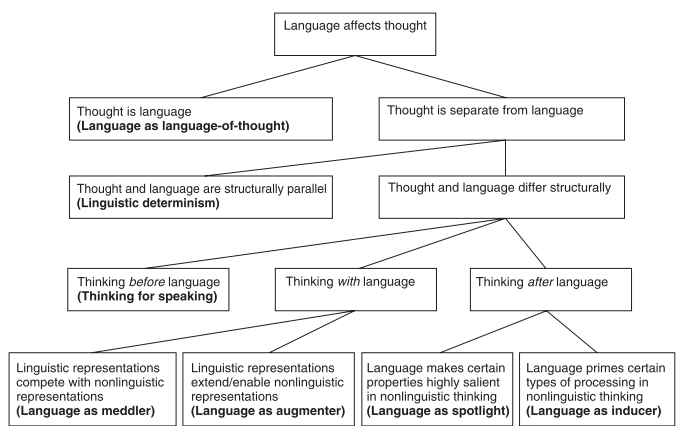
On a very general level, then, we can all agree that thought is separate from language. But what about the many different ways language can affect thought?
Here, we can first make a distinction between views that hold that language determines thought (linguistic determinism), and those that hold that there are structural differences between language and thought, but that, nevertheless, language influences the way we think.

Linguistic Determinism

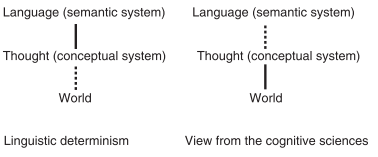
Linguistic determinism, a position most often connected to the name of Benjamin Lee Whorf, separates language from the conceptual system, but holds that the language we speak determines the basic categories of thought. This influence is seen as so strong that it can even overwrite pre-existing perceptual and categories in a way analogous to the way infants lose the ability to notice phonetic distinctions that do not exist in their native language. For example, at 6 months, infants growing up in English-speaking households are able to discriminate sounds that in Hindi are seen as different but in English are not, but at 12 months they have lost this ability and only pay attention to sound distinctions relevant to English (e.g. Dirven et al. 2007).
The linguistic determinism-hypothesis poses that this process also holds for many other areas of perception and, critically, cognition. To quote Whorf:

“The world is presented in a kaleidoscopic flux of impressions which have to be organized largely by the linguistic systems in our minds.”

“We cut up nature—organize it into concepts—and ascribe significances as we do, largely because of absolutely obligatory patterns of our own language.”

(Please note that in most of his writings, Whorf actually argues for a position that is much more sophisticated and subtle than the one expressed in these popular quotes)

If language is given the role of organizing “the kaleidoscopic flux of impressions” presented to us by the world, this means that on this view, there is a very tight connection between what we can call the conceptual system/thought, and language, one the one hand, and a very loose connection between the conceptual system/thought and the world on the other.
A lot of research in the cognitive sciences, however, indicates that the relationship between thought and the world is much tighter than is assumed in linguistic determinism. For example, languages differ in the way they talk about motion events, especially in the way they encode the direction or path of a motion, on the one hand, and the manner of motion on the other:

"Manner languages (e.g.,English, German, Russian, and Mandarin Chinese) typically code manner in the verb(cf. English skip, run, hop, jog), and path in a variety of other devices such as particles (out), adpositions (into the room), verb prefixes (e.g.,German raus- ‘out’; cf. raus-rennen ‘run out’), etc. Path languages(e.g.,Modern Greek, Romance, Turkish, Japanese, and Hebrew) typically code path in the verb (cf. Greek vjeno ‘exit’, beno ‘enter’, ftano ‘arrive/reach’,aneveno ‘ascend’, diashizo ‘cross’), and manner in adverbials(trehontas‘running’, me ta podia ‘on foot’, grigora ‘quickly’)." (Papafragou & Selimis 2010: 227)

However, studies by Anna Papafragou and others suggest that although, say, English and Spanish speakers talk differently about the same motion event, the still remember it similarly:

"both manner and path seem to be available to an equal extent to speakers of different languages for purposes of (non-linguistic) categorisation and memory, regardless of whether these components are prominently and systematically encoded in the language." (Papafragou & Selimis 2010: 229)

These results and other experiments suggesting that in some respects 'thought and language' are less well aligned than 'thought and world' of course pose a serious problem for linguistic determinism.

Other Ways Language Might Have an Effect on Thought

In sum, this means that two versions of the Sapir-Whorf-Thesis – the Language-as-Thought and Linguistic Determinism hypotheses – can be rejected. But this still leaves us with the many ways language can have an effect on thought.

As Wolff & Holmes note it is precisely because" language and the conceptual system differ that we might expect a tension between them, driving each system to exert an influence on the other."

Wolff & Holmes use 5 different metaphors to classify the ways this can happen.

  1. Thinking for speaking: Language influences thinking when we think about how to express something in language immediately prior to speaking
  2. Language as meddler: linguistic representations/language and non-linguistic representations/thought can conflict and compete with each other
  3. Language as augmenter: Language enables or extends certain kinds of thought
  4. Language as spotlight: Language directs attention to /makes certain aspects very salient in thinking
  5. Language as inducer: Language can be seen as a primining mechanisms that induces certain ways of thinking about something

In my next post, I’ll elaborate on these 5 subclasses of how language might affect thought.

[Cross posted at Replicated Typo]

References:

Dirven, René, Hans-Georg Wolf and Frank Polzenhagen (2007): "Cognitive Linguistics and Cultural Studies." In: Dirk Geeraerts und Hubert Cuyckens (Hrsg.): The Oxford Handbook of Cognitive Linguistics. Oxford: Oxford University Press, 1203-1221.

Papafragou, Anna and Stathis Selimis (2010): "Event categorisation and language: A cross-linguistic study of motion." In: Language and Cognitive Processes 25: 224-260.

Wolff, P., & Holmes, K. (2011). Linguistic relativity Wiley Interdisciplinary Reviews: Cognitive Science, 2 (3), 253-265

Monday, February 8, 2010

Biolinguistics, Cooperation, the Importance of Theory of Mind for Language - and Dinosaurs


Some interesting links:
  • The journal "Biolinguistics" now has a blog (here). On it they want to post "a variety of material pertaining to the field of biolinguistics." As of now there isn't very much content other than some information on conferences but I'll stay tuned.

  • On a related note, Julia Fischer of the Cognitive Ethology Laboratory at the German Primate Center in Göttingen, Germany has written a short review of Michael Tomasello's book "Why We Cooperate." I've written a short summary of the slim volume myself, but I seem to have msiplaced the document... Anyway, this review is by somebody who really knows the stuff and is quite enlightening.

  • Also, over at Babel's Dawn there is an interesting discussion of a paper by David Leavens and Tim Racine (abstract here) that questions whether it is really justified to attribute sophisticated psychological processes to preverbal infants in the way Michael Tomasello and many others do. Instead, they argue that learning and growing up in a human community play a much more important part that is normally acknowledged (first part here, second part here). Edmund Blair Bolles thinks that the argument has some merit but remains sceptical. In the comment section of his first post, the authors themselves weigh in.

  • Lastly, and not really relatedly, I really like this cartoon:
  • hat tip: Richard Beck


Friday, July 17, 2009

Language, Thought, and Space (III)


In the second chapter of his book, Stephen Levinson discusses a concept that has been crucial to this blog: frames of reference. (see e.g. these posts) The term as it is used today was coined by Gestalt theorists of perception in the 1920s and was used to signify the steady and constant background against which other objects could be made out and identified. It can be defined as “‘a unit or organization of units that collectively serve to identify a coordinate system with respect to which certain properties of objects, including the phenomenal self, are gauged’ (Rock 1992: 404, emphasis in Levinson 2003: 24).

Frames of references seem to be highly similar across modalities such as vision, touch, gesture, and language. Without these structural similarities (or ‘isomorphisms’) “we could not reach to what we see, or talk about what we feel with our hands, or give route descriptions in language and gesture.” (Levinson 2003: 25). There are, however, also differences: vision is viewer-centred, and touch and grasp are object-centred.

In general, frames of references can be classified by the following distinctions.
Absolute vs. Relative. Psychologically, the received view is that we organize our spatial thinking in relation to objects and ourselves. The frame of reference is thus relative to our own ego-centric bodily coordinates. An absolute frame of reference, on the other hand would consist of fixed angles with coordinates that do not depend on our personal egos as anchoring. And as we have seen, contrary to the received view, both kinds of frames of references are employed in the world’s languages. (Levinson 2003: 27f.).
Similar, but not completely identical is the differentiation between egocentric and allocentric frames of reference. This designates a difference
"between coordinate systems with origins within the subjective body frame of the organism, versus coordinate systems centred elsewhere (often unspecified).” (Levinson 2003: 28).

Our mental maps of our environment and our place are either egocentric or allocentric and landmark-based, including the relations, distances and angles between different landmarks, or allocentric and based on “fixed bearings.” These distinctions can not only be found in the world’s languages, but are also used by neuroscientists when they look at the mental map-building capacities of animals.
In studies of conceptual development it was also argued, following Jean Piaget, that for a long time ‘egocentric’ frames of reference are primary and that children switched to ego-centric frames of reference only to a much later date.

In studies of the visual system we often find a distinction between viewer-centred vs. object-centred. If we identify an object we are also able to mentally rotate it and imagine how it would look from another angle. This means that the retinal impression of the viewer gets interpreted and classified in a more abstract object-centred frame of reference during perception.
Another distinction made when looking at visual imagery and visual perception is that between orientation-bound vs. orientation-free. Orientation-bound information changes with perspective and change of location, whereas orientation-free information does not change. For example, when we rotate a d it can become a b, the information changes. But a ball looks the same from all perspectives and the information is thus orientation-free.
The most important distinction for psychology and language however, is the difference between
“viewer-centred frames, object-centred frames, and environment-centred frames of reference.Ina viewer-centred frame, objects are represented in a retinocentric, head-centric or body-centric coordinate system based on the perceiver’s perspective of the world. In an object-centred frame, objects are coded with respect to their intrinsic axes. In an environment-centred frame, objects are represented with respect to salient features of the environment, such as gravity or prominent visual landmarks. “ (Carlson-Radvansky & Irwin 1993: 224).
Levinson called these the relative, intrinsict and absolute frames of reference. (Levinson 2003: 33).

The distinctions made in various disciplines at times are quite confusing and there are many conflicting positions. However, a broad differentation such as this seems valid.
Next, we have to distinguish between three levels on which different frames of references can be constructed: perceptual, conceptual, and linguistic. There is especially much diversity on the linguistic level, which will be discussed in my next post. As I'm going home tomorrow I don't really know when I'll have access to the internet again, but I hope it wont't be too long.

Reference:
Carlson-Radvansky, L.A. and Irwin, D.A. (1993): Frames of reference in vision language: Where is above? Cognition
46: 223-244

Levinson, Stephen C. (2003) Space in Language and Cognition : Explorations in Cognitive Diversity. West Nyack, NY, USA: Cambridge University Press.

Rock, I. (1990), The frame of reference, in I. Rock (ed.), The legacy of Soloman Asch, pp. 243– 268. Hillsdale, NJ: Lawrence Erlbaum.

Thursday, July 16, 2009

Language, Thought, and Space (II)

Spatial orientation is crucial when we try to navigate the world around us. It is a fundamental domain of human experience and depends on a wide array of cognitive capacities and integrated neural subsystems. What is most important for spatial cognition however, are the frames of references we use to locate and classify ourselves, others, objects, and events.

Often, we define a landmark (say ourselves, or a tree, or the telly) and then define an object's location in relation to this landmark. (the mouse is to my right, the bike lies left of the tree, my keys have fallen behind the telly). But as it turns out, many languages are not able to express a coordinate system with the meaning of the English expression “left of.” Instead, they employ a compass-like system of orientation.

They do not use a relative frame of reference, like in the English “the cat is behind the truck” but instead use an absolute frame of reference that can be illustrated in English by sentences such as “the cat is north of the truck.” (Levinson 2003: 3). This may seem exotic for us, but for many languages it is the dominant – although often not the only – way of locating things in space.

What are the cognitive consequences of this? Levinson argues that “
the choice of a predominant frame of reference in language correlates with, and probably determines, many other aspects of cognition, from memory, to inference, to navigation, to gesture and beyond. “ (Levinson 2003: 3).

Levinson has done much work on two languages which feature absolute frames of references:
1. Guugu Yimithirr, an Australian Aboriginal language. Levinson recounts how a Guugu Yimithirr speaker once warned him of an army ant “north of his” foot, or how another one told him where to find the frozen fish in a store that was 45 kilometres away. He pointed to his left and Levinson, just as all speakers of Indo-European and many other languages would probably do, thought he meant that Levinson would find the frozen fish on his right-hand side when he entered the shop. But in fact, he had pointed north-east and intended to communicate to Levinson that he would find the frozen fish in the north-east corner of the shop.

Größere Kartenansicht

2. Tzeltal, a Mayan language. In Tzeltal, speakers use the hills that surround them as points of reference. If they are out of the hills, they still project their frame of reference on their environment. So a speaker asking “Is the hot water in the uphill tap?” in an unfamiliar hotel out of the hills would mean by this ‘Is the hot water in the tap that would lie in the uphill (southerly) direction if I were at home?’ (Levinson 2003: 4).

Größere Kartenansicht

Levinson was particularly impressed by a Guugu Yimithirr speaker who, when referring to a absent person, seemingly pointed at himself but in fact pointed to the place the person had lived before. For Levinson, this indicates that
“in some striking way, the ego has been reduced to an abstract point in space. (Levinson 2003: 5)”

These experiences fit perfectly into and are supported by a more thorough and experimental investigation of this matter. But they fly in the face of much of traditional western thinking on the topic, including the consensus on the nature of spatial thinking in much of cognitive science, psychology, and linguistics which held that it was organized in a relative, egocentric and anthropocentric manner. (Levinson 2003: 10f.).

And in the chapters of his book Levinson sums up a robust body of data that lend support to his thesis that spatial cognition may be differently organised in different cultures, and that the body may not be the fundamental source of our spatial concepts, neither developmentally nor cross-culturally.

However, there are still strong universal trends in cognition in the domain of space. According to Levinson the best way to accommodate all these findings is to concede that human cognition may employ several modes of internal representation and that there is no reason to assume that there is only one form of mental representation. If we accept this view, it seems much more logical to state that the internal representations accessed by and linked to language and cultural practices are in some way influenced and shaped by these linkages. (Levinson 2003: 21f.).
Levinson sums up the key issues that recur throughout his book as follows:

  • “What are the ‘natural’, pre-linguistic or innate, spatial concepts in human cognition? How abstract are they? Why does spatial thinking have a centrality in human cognition?
  • What is the role of bodily axes and coordinates in spatial cognition?
  • What is the nature of the relation between linguistic categories and non-linguistic concepts, both in general and in the spatial domain? Are there a multiplicity of underlying representations, or one multimodal representation of space? If the latter, what is its relation to spatial semantics?
  • How much linguistic diversity is there in this domain, not only in expressive form, but underlying semantic parameters? Given that there is diversity, what linguistic universals can be stated in this area?
  • Given semantic diversity, what happens to the underlying cognition? Does it remain a universal constant, translated into various restricted linguistic concepts, or does it adapt to the language it must locally support?
  • What are the general implications from the spatial domain for the relation between language and human thinking?” (Levinson 2003: 22f.)

References:

Levinson, Stephen C. (2003) Space in Language and Cognition : Explorations in Cognitive Diversity. West Nyack, NY, USA: Cambridge University Press.

Wednesday, July 15, 2009

Language, Thought, and Space (I)


I know I still haven't written my third post on Lewontin's paper in which he criticises inquiries into the evolution of language and cognition and it will be some time until I'll be able to post it as I'm going back home on Saturday and won't haven internet access for more than a month.

But in the next couple of days I want to write something about different: How different cultures speak about and conceptualize space.
In my opinion, this is a very fascinating avenue of linguistic research that gives much insight into the nature of language and cognition as well as their relationship. In addition, it also presents us with new facts and considerations when we try to study the evolution of these traits.
By studying language and cognition cross-culturally we come to the problem of language evolution from the other way so to speak.

I will focus on the work of the Max-Planck-Institute for Psycholinguistics in Nijmegen, Netherlands and especially on the introductory part of Stephen Levinson's (2003) book "Space in Language and Cognition." I've started reading it because I wanted to improve my knowledge of some aspects of the cognition-oriented strands of linguistics and anthropology I unfortunately know way too little about.

I’ve written about the idea of frames of references and cognitive coordinate systems before , I haven’t said much about linguistic data that bears on this question. More generally, I, following other researchers, have argued that cognition and cognitive representations of communicative interactions are to a large part spatial in nature or at least analogous to spatial thinking. But research done by the people at the Max-Planck-Institute for Psycholinguistics in Nijmegen, Netherlands and others has shown that there is a surprising diversity in linguistic frame of references across cultures.

What exactly does this mean for any account of cognition? What we have here is of course related to the contentious issue of the relation of language and thought. Generally there people who tend too emphasize the importance of a Language of Thought over language itself (e.g. cognitivism), with others tending toward the view that language and culture shape your cognitive style to a significant amount (e.g. linguistic relativism, linguistic determinism). These theorists can be called “lumpers” who do not see it necessary to distinguish between the semantic content of a language and underlying conceptual representations, and “splitters” who insist on this distinction. (Levinson 1997: 13f.)

The issue is often seen as a black and white matter, with Benjamin Lee Whorf being portrayed as the bad guy who had a way too extreme view. This, however, is misguided, as Whorf’s main interest was not to advocate any idea of linguistic determinism per se but instead to stress the importance of how perspectives embodied in a language influence what we pay attention to in a situation and also how we conceptualise it: “‘users of different grammars are pointed by their grammars toward different types of observations and different evaluations of externally similar acts of observation, and hence are not equivalent as observers but must arrive at somewhat different views of the world’” (Whorf 1956: 221).

This is not to say that language is a prison we can’t get out of. But, as language and social practices can be said to embody certain perspectives on the world, it is reasonable to argue that a child growing up in a certain community will also learn to adopt and construe these perspectives during her cognitive development. As language is a primary source that introduces children to new ways of organizing the world around them it stands to reason that the concepts and viewpoints expressed in a language have a significant impact on cognitive representations.

Of course research on the non-linguistic cognition of infants and non-human primates has shown that their mental representations are already surprisingly sophisticated and complex. Some of these cognitive capacities are certainly specified innately or at least helped by innate biases. Others may emerge due to the nature and early imprint of cultural interaction. But some concepts, namely abstract, relational ones, seem to be absent from non-human cognition completely, and in humans seem to be provided and picked up primarily by and through language during cognitive development. In fact, research on infant and childhood cognition supports the fact that the acquisition of relational concepts with the help of language may be one of the key factors that made us “so smart” (Gentner 2003, Penn et al. 2008).

If we bear this in mind, the question then is not whether language influences or determines thought, but to clarify the interactions and relationship between innate biological propensities, the environment, language and other cultural practices. If for example, we allow for multiple modes of representation in cognitive processing we may get a much clearer view on the issue. If, as mentioned above, we see semantic representations and conceptual representations as different levels of representation we can accommodate the variety of semantic distinctions in different levels with maintaining some form of ‘psychic unity of mankind’ with shared atomic concepts across our species. (Levinson 1997)

In my next post I’ll write about how the research done by the Max-Planck-Institute for Psycholinguists on the relationship between cross-linguistic differences in descriptions of space sheds light on this topic. I will draw on the 2003 book Space in language and cognition: explorations in cognitive diversity by Stephen C. Levinson, the director of the language and cognition group at the institute, in which he sums up much of the research that was done there over the years.

References:
Gentner, D. (2003). Why we’re so smart. In D. Gentner and S. Goldin-Meadow (Eds.), Language in mind: Advances in the study of language and thought (pp.195-235). Cambridge, MA: MIT Press.

Levinson, Stephen C. (1997) From outer to inner space: Linguistic categories and non-linguistic thinking. In E. Pederson & J. Nuyts, eds., With Language in Mind: the Relationship Between Linguistic and Conceptual Representation, 13-45. Cambridge: Cambridge University Press.

Levinson, Stephen C. (2003) Space in Language and Cognition : Explorations in Cognitive Diversity. West Nyack, NY, USA: Cambridge University Press.

Penn, Derek C, Keith J. Holyoak. and Daniel J. Povinelli (2008): Darwin's mistake: Explaining the discontinuity between human and nonhuman minds. In: Behavioral and Brain Sciences (31:2): 109-130.

Whorf, B.L. (1956,) Language, thought and reality, Cambridge, MA: MIT Press.

Wednesday, November 26, 2008

Biolinguistics

Orignally I just wanted to write about an article in the November 14th issue of Science about describing The „Biolinguistic Agenda“ by Marc Hauser and Thomas Bever, but as it seems it has already been covered by Edmund Blair Bolles over at Babel's Dawn.

Bolles is very critical of the generative enterprise and also seems to be rather unhappy with Hauser & Bever's (2008) article. He writes:

the paper […] shows where riders in biolinguistic's conservative caboose think the train is going, and for the way it clarifies how much our present-day understanding has changed from what it was in the recent past.

Although I share many of the problems he has with the generative enterprise, I still think he is a bit hard on Hauser & Bever. To elaborate on what is meant by biolinguistics, I'll refer to an article published in the foundational issue of the journal “Biolinguistics” called “The Biolinguistics Manifesto” by Cedrick Boeckx and Kleanthes K. Grohmann.

Bolles criticizes the definition of biolinguistics that Hauser & Bever give, which as he rightly points out, is a bit technical. They simply gloss it as the

“ study of the computational systems inherent to language.”

Bolles argues that biolinguistics would be better and simpler defined as “the study of how human brains produce language.” But what he seems to forget is that biolinguistics is a term most often used by researchers in a Chomskyan vein to refer to biological and cognitively but at the same time often Chomskyan and formally oriented studies of human language.

They use this term to differentiate themselves from other biologically and cognitively oriented branches of linguistics such as Cognitive Linguistics or the neurobiological study of language, neurolinguistics. On the other hand, they also use the term

to highlight the commitment of the generative enterprise to the biological foundations of language, and to emphasize the necessarily interdisciplinary character of such enterprise” (Boeckx & Grohmann 2007 : 2)

Thus the journal Biolinguistics primarily publishes articles written in a Chomskyan vein (some of them seeming quite opaque and fanciful to the informed layman, such as articles on the Optimal Growth in Phrase Structure or the Combinatorics for Metrical Feet) but also critical commentaries, for example by Dan Dediu and Robert Ladd.

According to Boeckx & Grohmann (2007) biolinguistics, sees “the study of the language faculty as a branch of biology, at a suitable level of abstraction" and focuses on the following questions:

"1. What is knowledge of language?

2. How is that knowledge acquired?

3. How is that knowledge put to use?

4. How is that knowledge implemented in the brain?

5. How did that knowledge emerge in the species"

Hauser & Bever (2008): write that

"to fulfill a biolinguistic agenda [...] we must address the rules and constraints that underlie a mature speaker's knowledge of language; how these rules and constraints are acquired; and whether they are mediated by language-specific mechanisms. We also need to distinguish which rules and constraints are shared with other animals and how they evolved, and to ask how knowledge of language is used in communicative expressions.”

Bolles rightly remarks that the definition of Hauser & Bever (2008):

catches the flow only in one direction, from rules in the brain to external "instantiation" of the rule. It ignores the way language can reflect many other things.”

In my opinion Boeckx & Grohmann 's (2007) questions of How knowledge is acquired and implemented in the brain seems to be open to all kinds of external factors and two-way processes people like Morten Christensen, Nick Chater, Simon Kirby, and others focus on.

And though the biolinguistic agenda is of course incomplete, I think the problem has to be approached from both sides.

Boeckx & Grohmann (2007) note this by quoting the earliest known definition of researchers in a biolinguistic paradigma. They saw themselves as looking

upon language study […] as a natural science, and hence regard[ing] language as an integrated group of biological processes“ and seeking „an explanation of all language phenomena in the functional integration of tissue and environment” (Meader & Muyskens 1950: 9).“

As Bolles writes, biolinguistics is not able to answer all of the questions that come up when studying language, and its an open questions which questions are the most important ones.

But if they hold up their end in finding out more about the internal nature of what „differentiates my granddaughter from rocks, bees, cats and chimpanzees” (Chomsky 2002), when they are all placed in the same environment, maybe researchers from other directions are better able to flesh out what external factors contribute to the wonderful phenomenon of language.

References:

Boeckx, Cedrick and Kleanthes K. Grohmann (2007): The Biolinguistics Manifesto. Biolinguistics 1. 1-8.

Chomsky, Noam (2000): Chomsky, Noam (2000) The Architecture of Language, edited by Nirmalanshu Mukherji, Bibudhendra Narayan Patnaik, and Rama Kant Agnihotri. Oxford University Press.

Hauser, Marc & Thomas Bever (2008): A Biolinguistic Agenda. Science 322, 1057 – 1059.

Meader, Clarence L. & John H. Muyskens. )(1950). Handbook of Biolinguistics. Toledo: H.C. Weller

Sunday, September 14, 2008

Social Cognition and Linguistic Innateness I

Normal 0 21 false false false MicrosoftInternetExplorer4

Laughing Man of Complex Adaptive Systems has asked an interesting question regarding my post announcing that Michael Tomasello had published a new book on “The Origins of Human Communication:”

A point I don't get: How does this argument (Gricean maxims of cooperation evolved from general cooperative human structure) criticise Chomsky's innateness theory?”

He refers to the following passage from the book description:

“Challenging the Chomskian view that linguistic knowledge is innate, Tomasello proposes instead that the most fundamental aspects of uniquely human communication are biological adaptations for cooperative social interaction in general and that the purely linguistic dimensions of human communication are cultural conventions and constructions created by and passed along within particular cultural groups”

As Laughing Man rightly points out, the evolutionary priority of cooperative, social-communicative capacities to our capacity for linguistic communication is in principle compatible with an innatist position regarding language acquisition. A generativist more interested in interdisciplinary matters than Chomsky, as for example, Ray Jackendoff, would be sure to agree with the importance of social interaction for language acquisition.

However, Tomasello’s argument goes further than that. He claims that general skills of social interaction such as human intention-reading skills, along with primate pattern finding skills, are all what is needed for a child to be able to learn a language when placed in the right environment. I haven’t looked at Tomasello’s newest work, but in his previous books “The Cultural Origins of Human Cognition” (1999), and “Constructing A Language” (2003), he makes a strong case why we needn’t postulate a language-specific, innate “Universal Grammar” specifying the architecture and input conditions of a domain-specific language system.


In Contrast, here’s Ray Jackendoff’s opinion on the relationship between social cognition and an inbuilt specialized linguistic toolkit:

“Language acquisition of course rests on social skills such as theory of mind (rudimentary in chimpanzees) and understanding pointing (not found in chimpanzees), as well as on more general perceptual machinery such as attention. These provide scaffolding for language acquisition but do not themselves provide the material out of which knowledge of language is built. “

Language also relies on many other domain-general cognitive capacities, but

“what is special about language is the collection of mental structures it employs – phonology and syntax – and the interfaces between them and conceptual structure. The processing and acquisition of these structures may be accomplished by brain-general mechanisms of long-term memory, integration in working memory, learning (including statistically-based learning), and attention, and may rely as well on understanding of social interaction and theory of mind. But unless the specific unique building blocks for phonology, syntax, and their connection to concepts are present, language and language acquisition are not possible. It is these building blocks that constitute the narrow language faculty.” (Jackendoff 2007: 388f.)

References:

Jackendoff, Ray (2007): Linguistics in Cognitive Science: The State of the Art, The Linguistic Review 24, 347-401.

Tomasello, Michael (1999): The Cultural Origins of Human Cognition. Cambridge, Massachusetts; London, England: Harvard University Press.

Tomasello, Michael (2003): Constructing A Language. A Usage-Based Approach. Cambridge, Massachusetts; London, England: Harvard University Press.

Sunday, June 22, 2008

Thriller-Writer Lee Child and Linguist Dieter Wunderlich on the Evolution of Language


Lee Child is one of my favorite Thriller-authors. Normally I don’t find the time to read non-studying related fiction, but I especially enjoy his audio books because of the cool American accent of the narrator. However, when I stumbled on an essay by Lee Child called “The Origin of the Thriller”, I was a bit confused. Here’s his take on the evolution of language: According to Lee Child, a couple of hundred thousand years ago, Neanderthals and humans, the only homo “contenders” left were competing for resources, and Neanderthalers had the upper hand:

“They were heavier and stronger and faster. They were superb tool makers. They were much better equipped to survive the brutal conditions of prehistory.

But they didn't survive. We did. Why?

Because Homo Sapiens developed language. Many primitive species could communicate by making sounds — and many still do: prairie dogs make distinctive noises if a predator is spotted — one noise for a ground predator, and another for an airborne predator. But Homo Sapiens went beyond two words. After a random mutation our brains grew large and the new capacity was colonized by language, with a theoretically infinite number of available words, and more importantly with syntax, such that as well as reporting we could plan and speculate. Not just: a predator is coming, but also: a predator will come, or might come. Not just reaction, but also prediction: if we do this, we'll be OK, or if we do that, we'll be in trouble. “

But here’s the gem According to Child, humans are weak and fragile and in disorganized groups we would quickly be killed by predators:

“But a coordinated crowd of two hundred humans is the most powerful animal on earth. The heaviest, the strongest, the hardest to stop, the hardest to kill. Thus, grunting Neanderthals slowly died out, despite their muscle and bone and strength and speed, and talking humans marched on toward the present, despite our slender limbs and fragile skulls”
The last Sentence is faboulus isn’t it? We better don’t tell him anything about Neanderthal-DNA, Neanderthal Vocal Anatomy, FOXP2, Introgression, etc.

But I want to present a more plausible and worked out view on the topic. Yesterday I was searching for material on the evolution of syntax, because a friend of mine asked me to comment on a section of his MA-Thesis in which he shortly discusses the topic. (For a discussion of the speculation, that certain features of language are ‘living fossils’, or vestiges of an older proto-language, see this post).

On my search I found the slides of a talk given by German linguist Dieter Wunderlich on the evolution of language, that he held in Leipzig, Germany, in December 2007. The talk and the slides are in German, but because he offers a very comprehensive and nice review on some aspects of the current state of the art in language evolution research/evolutionary linguistics, I decided to write an English summary of it.


Key Questions

When looking at the evolution of language, there are three question that guide our inquiry:

1. How exactly did language get started? What is hotly debated is whether it evolved in a gradual manner (continuist/adaptationist position: see e.g. Pinker & Bloom 1990) or in a ‘sudden leap’ (discontinuist/ exaptationist: see e.g. Hauser et al. 2002)

2. When did language evolve? Depending on our answer to question 1., the question would be when each step toward language took place, or when the big leap happened.

3. Did language evolve only once or several times?


What is language?

Basically, language can be described as a system for expression, that relates Utterances and meaning to one another, in relation to certain contexts.

Morphosyntax governs the construction of complex utterances out of smallest units of language, namely lexical entries (=”words” in your mental lexicon) as well as morphemes (-s, -ed, un-, -er, etc.). Its system is compositional, that is every construction leads to complex expressions of meaning which are determined by the single lexical entries as well the rules that govern their combination. The rules governing the compositional construction of utterances are recursive.

There are two interfaces to non-linguistic abilities:

1. an interface with the system responsible for the production and perception of sounds and gestures (In generativist terminology this would be the Sensori-Motor System (SM) or the Articulatory-Perceptual (AP) System)

2. an interface with our mental representations and our discourse intentions (in generativist terminology: the Conceptual-Intentional (CI) system. cognitive linguists would probably call it our conceptual system)


Important events which shaped the current state of language

There are 5 important events that have shaped how languages and our mental structures that enable us to use it look:

In chronological Order:

1. There was an expansion of the cortex (frontal lobe) in early hominids such as homo erectus, who lived approx. 2 million years ago. In just 1 million years, brain size rose from 600 to 1400ccm. This may be related to the begin of an ice-age about 2.5 million years ago.

2. Anatomically modern man (homo sapiens) probably evolved about 170.000 years ago in east Africa.

3. Starting from about 50.000 years ago, there is archaeological evidence of improved tool-making capacities, burials, ornaments, and figurative art in several parts of the world (the so-called Upper Palaeolithic Revolution). In Africa these features can be found even earlier, as is especially salient from about 85.000 years ago, which even led some researchers to call this period an “African Upper Palaeolithic” (see e.g. Dubreuil 2008).

4. From 12.000 years ago onwards, there was a spread in agriculture which seemed to have happened independently in several parts of the world (The Neolithic Transition)

5. Starting from 6000 years ago, writing systems were developed independently in several parts of the world.

Of these 5 events, the first three are biological of nature, whereas the last two are cultural events. A diversification of biological events brought about by mutations and selection led to one single event: genetically modern man. In principle, every human being can reproduce with every other opposite-sex human, which fulfils the criterion of biological species. Furthermore, every child, regardless of its parents, can learn every language of the world when it is put into the critical environment at the right age. Thus language is a common and uniting feature of humans, and we all share the genetic structure that enables us to learn language (but for evidence that there is still genetic variation on a small scale, see these two posts)


What are the differences between and non-human communication systems?

Influential linguist Charles F. Hockett has posed 13 ‘design features of language’, 7 of which are especially interesting regarding the evolution of language. These are:


1. For the majority of human languages, the vocal-auditory channel the basic mode of communication.


2. Parity/Interchangeability: hearer and speaker constantly switch roles during conversation, which also means that a communicator is able to both produce and receive the same signal, which isn’t the case with say, gender-specific calls in sticklefish.


3. Semanticity/Arbitrarines: specific signals can be equipped with specific meaning in a manner where there is no necessary or logical connection between form meaning (“table” has nothing to do with any actual properties of a table)


4. Displacement: humans can talk about things that are not present in their immediate environment, or even things that do not exist at all (say, for example, my comprehension of mathematics). Human reference thus extends “beyond the horizon” and the perceptual space, but extends to mental spaces and shared systemic spaces.


5. Honey bee communication about the location of nectar of course is also displaced, but it only built to convey very specific information, and is not unbounded and productive like human language.


6. Traditional Transmission/Learnability human children are able to learn the language of their environment. As W.v.O. Quine said “language is a social art”, which essentially depends on the ability to be part of and interact with a complex culture that transmits complex behavior and knowledge. This complexity and language-specificness is probably the dividing feature, because song-birds also have to learn their songs from other birds, vervet monkeys need to be reinforced in their innate tendencies to hiss at snakes and have to zoom in on the exact referent for eagle alarm callas through positive reinforcements by other group members, and chimpanzees have been shown to adhere to some forms of social transmission and conformity as well as for rational imitation (e.g. Whiten et al. 2005)


7.Discreteness/Duality of Patterning the smallest units of language combine with each other in a systematic and combinatorial manner (that is Phonemes/Sound units combine to form Morphemes) , which then also combine in a systematic fashion (Morphemes built whole words and then sentences). This method allows for “infinite expression by finite means” (Humboldt) and is responsible for the diverse displaced productivity of language.

Wunderlich argues that homo erectus already possessed most of these features, but maybe not 6. and 7.


So what could homo erectus do?

Although he certainly didn’t have full-fledged human language, he was able to perform complex and social tasks. From 1.5 million years ago onwards, he was able to keep a fire burning, and from 0.8 million years ago he could even make fire.

He was able to make hand-axes (1.4 million years ago) and was also able to throw them, which, according to William Calvin, is suggested by neuropaleontological evidence. He way able to hunt together with other group members. He was very mobile: signs of him can be found in Georgia (1.8 million), later on there are also signs in China, Indonesia, and Europe.

Homo erectus was divided in several species that probably lived alongside each other. The last ones co-existing with us were the Neanderthals.


Tool use

Chimpanzees and orangutans use tools (see here, for a cool post on spear fishing in orangutans)such as sticks for termite fishing, stones to crack open nuts, and leaves to soak up water, but these tools are contextually available, that is they do not have to be crafted in the same complex way as hand-axes, for example. Interestingly, there is population level handedness of 2:1 in chimpanzees. Termite fishers are mostly left-handed, whereas nut-crackers and wadge-dippers are mostly right-handed, this means that handedness seems to be heritable. In humans, the left-right ratio is 9:1. The distribution of handedness means that handedness is task-specific, and “

that the motor and cognitive demands of different tasks can have a significant influence on handedness in human and nonhuman primates” (Lanson & Hopkins 2005).
This means
“that antecedents of lateralization of function associated with hand use were present at least 5 million years ago, before the Pan-Homo split,”
and that due to tool-use the human-brain specialized, probably making possible further changes in human neurology and cognitive behaviour (for evidence that there is a neurological link between tool-making and speech, see this post). It is interesting to consider what the cognitive preconditions were that enabled tool-making. The Oldowan technique, which
can be found from 2.6 million years ago. This technique is used to make cutting tools by breaking off sharp-edged flakes from a larger stone. This is achieved by striking a core stone with a hammerstone, thereby knocking flakes from the core (see Ambrose 2001).


This technique definitely requires intentional planning that isn’t bound to the here-and-now, but directed at the future. Also, and more important for language, it requires the ability for complex propositional thought. Thus the following conscious key cognitive mechanisms found in language are also necessary for tool-making and thus already existed 2.6 million years ago:


1. Predication: the same referent (core stone), can be subject of different predications, a structure that can be called “Topic-Comment”-structure (see also this post):

George (Topic) is eating brains (Comment) / George (Topic) is a Zombie (Comment) / George (Topic) is (Comment).

2. Qualification of predications that have already been made and higher-order temporal hierarchical ordering.

To wit, what this basically means is that both in linguistics and tool-making you first have an initial structure which you change by commenting/acting on it. This new structure can then be the topic of new comments or actions, and the new structure arising from these computations/ actions can again be the topic of new predications and ad infinitum. Consider for example the sentence: The living homeless, who wanted money, had infested South Park, but then they went to California

A hierarchical behavioral sequence like toolmaking seems to have similar properties:


I don’t know about you, but for me this looks like recursion, the only difference being that for toolmaking the recursive operation are applied to a physical object, and for language they are applied to a mental object. However, if toolmaking requires intentional planning, there had to be at least some recursive mental operations that in mental action planning. This would mean that, pace Hauser et al. (2002), recursion is neither special to language nor recently evolved.

As Wunderlich writes in his (2006) paper “What forced syntax to emerge?”

"Both fast processing and mapping from hierarchical structure to temporal ordering, two other fundamental features of human language, can be attributed to progresses in the timing of actions necessary for producing and using hand axes, [as well as throwing] that is, to sensomotoric skills that could have been adapted for language.”

All this is made all the more exciting by converging evidence that combinatorial and hierarchical structure of any kind (be it linguistic, cognitive, or sensori-motor are constructed by the same part of the brain and via the same mechanisms:

“Similarities exist between the architecture for sentence structure and blackboard architectures for combinatorial structures in visual cognition, derived from the structure of the visual cortex” (van der Velde & de Kamps 2006: 1)

“Evidence is mounting that much temporally sequenced hierarchical structure is constructed by the same part of the brain – roughly Broca’s area and subcortical areas connected to it – whether the material being assembled is language, dance (Lieberman 2005: 297), hand movements (Lieberman 2005: 294; Wilkins 2005: 279), or music (Patel 2003). Nor, within language, is Broca’s area confined to syntax, as often asserted: it also appears to play a role in phonological and semantic combinatoriality, possibly in distinct though overlapping subareas (Hagoort 2005; Poeppel and Embick 2005)" (Jackendoff 2007: 388)

“On the basis of all these results, it can be hypothesized that [the recursive morphosyntax of modern language] is the computational output of a cortical premotor network originally evolved to control/represent the hierarchical structure of goalrelated action When in evolution, selective pressure led to the emergence of language, the same neural circuits doing computations to control the hierarchy of goal-related actions were ‘exploited’ to serve the newly acquired function of language syntax. A similar functional overlap between action and language acquisition is indeed evident during children’s development, i.e. children parallel their capacity to master hierarchical complexity both in the domain of language and goal-related action.“ (Gallese 2007: 666)”

That’s it for today. In my next post I will continue my summary of Wunderlich’s presentation.


References:


Ambr Ambrose, Stanley H. 2001. Paleolithic Technology and Human Evolution. Science 291, no. 5509 (March 2): 1748-1753. doi:10.1126/science.1059487.


Dubreuil, Benoît (2008): “What do modern behaviours in Homo sapiens imply for the evolution of language?”, in A. D. M. Smith, K. Smith, and R. Ferrer i Cancho (eds.), The Evolution of Language. Proceedings of the 7th International Conference (Evolang 7), World Scientific, 99-106.


Gallese, Vittorio (2007). Before and below 'theory of mind': Embodied simulation and the neural correlates of social cognition. Philosophical Transactions of the Royal Society B-Biological Sciences 362 (1480):659-669


Hagoort, Peter (2005). On Broca, brain, and binding: a new framework. Trends in Cognitive Sciences 9: 416–423


Hauser, Marc D., Noam Chomsky and W. Tecumseh Fitch (2002). “The Faculty of Language: What Is It, Who Has It, and How Did It Evolve?” In: Science 298, 1569-1579.


Jackendoff, Ray (2007): Linguistics in Cognitive Science: The State of the Art, The Linguistic Review 24, 347-401.


Lieberman, Phillip (2005): The pied piper of Cambridge. The Linguistic Review 22: 289–302.


Lonsdorf, Elizabeth V., and William D. Hopkins. 2005. Wild chimpanzees show population-level handedness for

tool use. Proceedings of the National Academy of Sciences 102, no. 35 (August 30): 12634-12638. doi:10.1073/pnas.0505806102.


Patel, Aniruddh D. (2003). Language, music, syntax, and the brain. Nature Neuroscience 6: 674– 681.


Pinker, Steven & Paul Bloom (1990). “Natural Language and Natural Selection.” In: Behavioral and Brain Sciences 13.4: 707-726.


Poeppel, David, and David Embick (2005). Defining the relation between linguistics and neuroscience. In Twenty-first century psycholinguistics: Four cornerstones, A. Cutler (ed.), Hillsdale, NJ: Erlbaum.


Van der Velde, F. & de Kamps, M. (2006). Neural blackboard architectures of combinatorial structures in cognition. In: Behavioral and Brain Sciences, 29, 1-72.


Whiten, Andrew, Victoria Horner & Frans B. M. de Waal. 2005. “Conformity to Cultural Norms of Tool Use in Chimpanzees.” Nature 437: 737-740.


Wilkins, Wendy K. (2005). Anatomy matters. The Linguistic Review 22: 271–288.


Wunderlich, Dieter (2006): “What forced syntax to emerge?” In H.-M. Gärtner et al. (eds.) Between 40 and 60 puzzles for Krifka. ZAS Berlin