Showing posts with label Language and Thought. Show all posts

Saturday, May 7, 2011

Does Language Shape Thought? Different Manifestations of the Idea of Linguistic Relativity (I)

Does the language we speak influence or even shape the way we think? Last December, there was an interesting debate over at The Economist website with Lera Boroditsky defending the motion, and Language Log’s Mark Liberman against the motion (who IMO, both did a very good job).
The result of the online poll was very clear: 78% agreed with the motion, while 22% disagreed.

There are, however, three main problems with this way of framing the question: First, it’s not really clear what ‘language’ really is, second, the same goes for “thought”, and third, there are many many ways of “influencing” and “shaping” something an bee conceptualized.
In this post I want to focus on the third problem and present a very useful classification system for hypotheses about linguistic relativity outlined in an article by Phillip Wolff and Kevin J. Holmes, which was published in the current issue Wiley Interdisciplinary Review: Cognitive Science.

Different manifestations of the idea of linguistic relativity

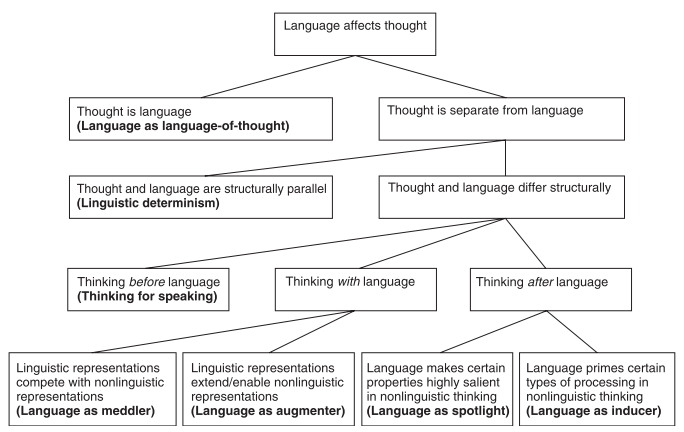
Language as Language-of-Thought
In its most extreme form, thought is simply equated with language. But this view, in which the units of thought are simply words from natural language, clearly can’t be right. For example, we can have thoughts that are difficult to express, we can understand ambiguous expressions (like “Kids make nutritious snacks”), and we are able to coin new words that express new meanings. All this would not be possible if we didn’t have a more fine-grained mental representation that that is encoded in words. In addition, research on non-human primates and human infants suggests that they are capable of some sophisticated forms of thought even in the absence of language.
This line of reasoning points to a representational format for concepts, categorization, memory, and reasoning that is separate from language.

On a very general level, then, we can all agree that thought is separate from language. But what about the many different ways language can affect thought?
Here, we can first make a distinction between views that hold that language determines thought (linguistic determinism), and those that hold that there are structural differences between language and thought, but that, nevertheless, language influences the way we think.

Linguistic Determinism

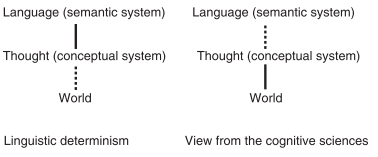
Linguistic determinism, a position most often connected to the name of Benjamin Lee Whorf, separates language from the conceptual system, but holds that the language we speak determines the basic categories of thought. This influence is seen as so strong that it can even overwrite pre-existing perceptual and categories in a way analogous to the way infants lose the ability to notice phonetic distinctions that do not exist in their native language. For example, at 6 months, infants growing up in English-speaking households are able to discriminate sounds that in Hindi are seen as different but in English are not, but at 12 months they have lost this ability and only pay attention to sound distinctions relevant to English (e.g. Dirven et al. 2007).
The linguistic determinism-hypothesis poses that this process also holds for many other areas of perception and, critically, cognition. To quote Whorf:

“The world is presented in a kaleidoscopic flux of impressions which have to be organized largely by the linguistic systems in our minds.”

“We cut up nature—organize it into concepts—and ascribe significances as we do, largely because of absolutely obligatory patterns of our own language.”

(Please note that in most of his writings, Whorf actually argues for a position that is much more sophisticated and subtle than the one expressed in these popular quotes)

If language is given the role of organizing “the kaleidoscopic flux of impressions” presented to us by the world, this means that on this view, there is a very tight connection between what we can call the conceptual system/thought, and language, one the one hand, and a very loose connection between the conceptual system/thought and the world on the other.
A lot of research in the cognitive sciences, however, indicates that the relationship between thought and the world is much tighter than is assumed in linguistic determinism. For example, languages differ in the way they talk about motion events, especially in the way they encode the direction or path of a motion, on the one hand, and the manner of motion on the other:

"Manner languages (e.g.,English, German, Russian, and Mandarin Chinese) typically code manner in the verb(cf. English skip, run, hop, jog), and path in a variety of other devices such as particles (out), adpositions (into the room), verb prefixes (e.g.,German raus- ‘out’; cf. raus-rennen ‘run out’), etc. Path languages(e.g.,Modern Greek, Romance, Turkish, Japanese, and Hebrew) typically code path in the verb (cf. Greek vjeno ‘exit’, beno ‘enter’, ftano ‘arrive/reach’,aneveno ‘ascend’, diashizo ‘cross’), and manner in adverbials(trehontas‘running’, me ta podia ‘on foot’, grigora ‘quickly’)." (Papafragou & Selimis 2010: 227)

However, studies by Anna Papafragou and others suggest that although, say, English and Spanish speakers talk differently about the same motion event, the still remember it similarly:

"both manner and path seem to be available to an equal extent to speakers of different languages for purposes of (non-linguistic) categorisation and memory, regardless of whether these components are prominently and systematically encoded in the language." (Papafragou & Selimis 2010: 229)

These results and other experiments suggesting that in some respects 'thought and language' are less well aligned than 'thought and world' of course pose a serious problem for linguistic determinism.

Other Ways Language Might Have an Effect on Thought

In sum, this means that two versions of the Sapir-Whorf-Thesis – the Language-as-Thought and Linguistic Determinism hypotheses – can be rejected. But this still leaves us with the many ways language can have an effect on thought.

As Wolff & Holmes note it is precisely because" language and the conceptual system differ that we might expect a tension between them, driving each system to exert an influence on the other."

Wolff & Holmes use 5 different metaphors to classify the ways this can happen.

  1. Thinking for speaking: Language influences thinking when we think about how to express something in language immediately prior to speaking
  2. Language as meddler: linguistic representations/language and non-linguistic representations/thought can conflict and compete with each other
  3. Language as augmenter: Language enables or extends certain kinds of thought
  4. Language as spotlight: Language directs attention to /makes certain aspects very salient in thinking
  5. Language as inducer: Language can be seen as a primining mechanisms that induces certain ways of thinking about something

In my next post, I’ll elaborate on these 5 subclasses of how language might affect thought.

[Cross posted at Replicated Typo]

References:

Dirven, René, Hans-Georg Wolf and Frank Polzenhagen (2007): "Cognitive Linguistics and Cultural Studies." In: Dirk Geeraerts und Hubert Cuyckens (Hrsg.): The Oxford Handbook of Cognitive Linguistics. Oxford: Oxford University Press, 1203-1221.

Papafragou, Anna and Stathis Selimis (2010): "Event categorisation and language: A cross-linguistic study of motion." In: Language and Cognitive Processes 25: 224-260.

Wolff, P., & Holmes, K. (2011). Linguistic relativity Wiley Interdisciplinary Reviews: Cognitive Science, 2 (3), 253-265

Saturday, August 15, 2009

Language, Thought, and Space (V): Comparing Different Species

As I’ve talked about in my last posts, different cultures employ different coordinate systems or Frames of References (FoR) "which serve to specify the directional relationships between objects in space, in reference to a shared referential anchor” (Haun et al. 2006: 17568) when talking about space. As shown in my last post these linguistic differences boil down to certain cognitive differences.
Whether speakers mainly use a relative, ego-based FoR, a cardinal-direction/or landmark-based absolute FoR, or an object-based, intrinsic based FoR, also influences how they solve and conceptualise spatial tasks.

In my last post I posed the question whether there is a cognitive “default setting” that we and the other great apes inherited from our last common ancestor that is only later overridden by cultural factors – and, crucially, which Frame of Reference is might be the default one?


Haun et al. (2006: 16570) argue that
"there has been a great deal of speculation about the inherited structure of spatial relational thought. Immanuel Kant argued that the human body provides the source of our basic intuitions about the nature of space. In agreement, many cognitive scientists hold the assumption that spatial cognition is fundamentally egocentric [references omitted].”
In the same vein, Dirven et al. (2007: 1213), point out that
“The principle of corporeal deixis [i.e. body-based or body-centric spatial reference] is even so self-evident that it has been considered by most linguists, including cognitive linguists, as the default case, if not the universal one (Talmy 1983).”
I myself also thought this way and found Karl Bühler’s (1934) notion of the ego-based “Here-Now-I”-origo quite self-evident. In Bühler’s view, this deictic centre is the origin of a “coordinate system of subjective orientation,” which builds the basis and referential anchoring for all communicative acts and all social interaction and coordination,

However, we can still see the egocentric frame of reference as the universal default case and see absolute frames of reference as being cultural variations that transform our innate frame of reference. This would thus still be in line with the paradigm mentioned above as well as with developmental psychologist Jean Piaget’s central assumption that in cognitive development infants start with an egocentric perspective on the world and only later learns to coordinate multiple perspectives on the world.

To test whether this is really the case, Haun et al. used a similar but simplified setting like in their first experiment that I described in my last post, and tested gorillas, chimpanzees, bonobos, orangutans, and 4-year-old German children.

This time there were only 3 identical cups on the table so the object-centred and the geocentric conditions from the previous experiment were collapsed.
The subject was first shown where a reward is hidden
(X = Cups | = Screen E= Experimenter O=Hidden Object)
and was then rotated 180° and brought to an identical table behind the screen where they could then again locate the reward.

In the Relative condition the reward was in relation to the subject. If it was hidden to his left on table 1 it was also hidden to his left on table 2 :
In the Absolute condition “the hiding and finding cups maintained position Relative to the larger, surrounding environment” and also to “a salient landmark between the two tables, namely the screen or the experimenter” (Haun et al. 2006 : 17569).
It turned out that the great apes including the 4-year old children deployed an allocentric/environment-based layout more readily than an ego/self-based spatial strategy. At the very least, these data indicate that
“Despite common expectations, [...] Hominid spatial cognition is at least not always primarily egocentric“ (Haun et al. 2006: 15751).
To further corroborate this evidence, Haun et al. 2006 tried an even simpler version of this task on the non-human great apes as they are known to have problems with abstract rule-learning and generally scored quite low on the second experiment.

Thus, in a third experiment, the subjects were directed to the first table and in the baseline condition were rewarded for picking a cup no matter which it was for 10 times. The animals were then led to the table that was on the other side of the screen and the experimenter started to only reward one of the cups until the apes consistently picked a particular cup ten out of twelve times in a row. If they had succeeded in doing so, they were redirected to the original table and in the test trials were again rewarded for all of their ten choices.
In this way, the experimenters induced a “response” or “training bias” in the apes: In the test condition they tended to preferably pick the same cup as the one for which they were rewarded 10 times in a row in the training condition. That is, if they were rewarded for picking the middle cup in the training session, they also preferred to pick the middle cup when rotated 180° and brought back to the original table in the test condition.


The interesting question then is: If they were rewarded for picking say this cup:

in the training condition: which cup would they show the response bias for in the test condition? Would they interpret this as being ‘the cup to their left’? Or would they interpret it as being allocentrically/environmentally based?
As in the second experiment, great apes showed a preference for environmental cues as opposed to self-based cues. That is if they developed a preference for the cup in the upper illustration, they then preferred to pick the following cup in the rotated test condition.
Haun et al. (2006: 17572) conclude that gorillas, chimpanzees, bonobos, orangutans, and we all have inherited “preference for allocentric spatial strategies” from our shared ancestor.

“Based on this result, we argue that, at least for small-scale spatial relations, the inherited cognitive mode of operation is not, as argued by Kant and others, egocentric but preferably deploys environmental cues as common reference between object.”
I think this is a fascinating result and I find the argument very convincing. It is also strengthened by findings from cognitive and linguistic development: By 16 months, when they have become successful mobile navigators, children competently use non-egocentric cognitive strategies. 3- to 5-year old English-speaking children even appear to be “better at allocentric strategies than at egocentric ones.” Moreover, in cultures where an absolute frame of reference is the dominant one, children master “this system as early as 4 and certainly by 7 years of age.” Children who live in cultures that dominantly employ a relative frame of reference, on the other hand, do not seem to master the full use of a left and right system until about 11 years of age. (Haun et al. 17572).

At first sight, this might seem like quite a blow for embodiment theories in Cognitive Science and Cognitive Linguistics who see embodied, egocentric experience as our primary way of making sense of the world.
But as Dirven et al. (2007) point out, “given the universality of human bodily experience,” it would not be “astonishing” if corporeal deixis constituted “the default case” of spatial cognition,
“but as a more refined conception of embodiment, the notion of situated embodiment incorporates and integrates man’s physical and social environment in his or her holistic bodily experience” (Dirven et al. 2007: 1217).


References:

Bühler, Karl. 1982. Sprachtheorie: Die Darstellungsfunktion der Sprache. Stuttgart,
New York: Fischer (Uni-Taschenbücher 1159).

Dirven, René, Hans-Georg Wolf, and Frank Polzenhagen. 2007. “Cognitive Linguistics and Cultural Studies.” In: The Oxford Handbook of Cognitive Linguistics, ed. by Dirk Geeraerts and Hubert Cuyckens. Oxford: Oxford University Press: 1203-1221.

Haun, Daniel B. M., Christian J. Rapold, Josep Call, Gabriele Janzen, and Stephen C. Levinson. 2006. “Cognitive Cladistics and Cultural Override in Hominid Spatial Cognition.” In: PNAS 103: 17568–17573.

Levinson, Stephen C. 2003. Space in Language and Cognition: Explorations in Cognitive Diversity. Cambridge: Cambridge University Press.

Levinson, Stephen C., Sotaro Kita, Daniel B.M. Haun, Björn H. Rasch. 2002. “Returning the Tables: Language Affects Spatial Reasoning.” In: Cognition 84: 155–188.

Palmer, Gary B. 2007. “Cognitive Linguistics and Anthropological Linguistics.” In: The Oxford Handbook of Cognitive Linguistics, ed. by Dirk Geeraerts and Hubert Cuyckens. Oxford: Oxford University Press. 1045-1073.

Pederson, Eric. 2007. “Cognitive Linguistics and Linguistic Relativity.” In: The Oxford Handbook of Cognitive Linguistics, ed. by Dirk Geeraerts and Hubert Cuyckens. Oxford: Oxford University Press. 1012-1044.

Talmy, Leonard. 1983. “How Language Structures Space.” In: Spatial Orientation: Theory, Research and Application. ed. by Herbert L. Pick, Jr., and Linda P. Acredolo. New York: Plenum Books. 225–82.


Friday, August 14, 2009

Language, Thought, and Space: (IV) Comparing Different Cultures.

I wanted to continue posting on Stephen Levinson’s 2003 book, but unfortunately, I only have very limited access to the internet right now, and as my year abroad at the University of Nottingham is over, I don’t have access to the e-book version anymore (The Library at the University of Heidelberg has a copy of the book but I’m currently at home and can’t get it from there either).

Instead, I’ll post about a fascinating study done by people from the Max-Planck-Institute for Psycholinguistics (Nijmegen, Netherlands) and people from the Max-Planck-Institute for Evolutionary Anthropology (Leipzig, Germany) that pretty much blew me away (quite literally so: it pretty much destroyed a central assumption of the received theory of cognitive perspective that I wanted to work on).

As I already said, work done by Stephen Levinson and others on how different cultures talk about and conceptualise space has shown that not all of them employ a bodily, egocentric frame of reference or coordinate system as their dominant organizing principle for their experiences and thoughts. Speakers of “several indigenous languages of Australia, Papua New Guinea, Mexico, Nepal, and south West Africa,” in contrast, organize the axes of their dominant coordinate system by absolute principles such as fixed landmarks (e.g. uphill vs. downhill) or cardinal directions (e.g. move the chair to the north). In addition, there are also languages that primarily use “intrinsic,” object-centred Frames of References, such as in “The dog is at the front of the library.”
In a set of clever experiments Levinson and his colleagues have also shown that speakers of relative and absolute languages differ in how they solve non-linguistic spatial tasks. For example, in the “motion-maze task” (Pederson & Schmitt 1993) participants see a toy move on a table. They are then rotated 180° and asked to recognize, on a table with a maze-like diagram, the “the path traversed from within a maze-like diagram containing both absolute and relative possibilities“ (Levinson et al. 2002).

Interestingly, speakers of relative languages such as Dutch or Japanese recognize the path based on the relative frame of reference they employ in their language whereas speakers of absolute languages such as the Australian Aboriginal language Arrernte or Tzeltal recognize the path based on their absolute frame of reference (Levinson et al. 2002, Levinson 2003).
Results like this were achieved on a wide array of space-based tasks, so the overall findings that relative speakers prefer relative FoR in spatial tasks and that absolute speakers prefer absolute FoRs seems to be quite robust. (Haun et al. 2006).
In a recent set of experiments Haun et al. (2006) tested how soon a cognitive bias in spatial cognition manifests itself. They tested 7-11 age year old children from a Dutch village, who mainly use an egocentric FoR) and from a Khoisan hunter–gatherer community in Namibia called =/= Akhoe Hai||om (to be honest, I don’t have any idea how to pronounce this), who almost always use absolute spatial descriptions.
They also tested adults of both cultures “to see whether differences were not only initial variations of an emerging cognitive skill but were actually stable across the life span.”
What they did was the following: The subject was placed in front of a table on which there were five identical cups in a “five dice”-constellation:
(X = Cups | = Screen E= Experimenter O=Hidden Object)


They were then shown the location of an object that was hidden under one of the cups.


In the next step, the Subject was turned 180° and brought to an identical table behind the screen:

Then, and this is the crucial bit, they were asked to indicate the spot where they thought the object was hidden this time. In the experiment, there were three conditions. First, an egocentric one: if the object was hidden to the left of the subject, it was also hidden to the subject’s left after she was rotated to her new position.


Secondly, there was an object-centred condition in which the “hiding and finding cups maintained position in relation to a salient landmark between the two tables, namely the screen or the experimenter” (Haun et al. 2006 : 17659).


And finally, there was a geocentric condition where, if the hiding cup was to the north-west, it would also be the to the north-west in the rotated position.


After repeated trials on all the conditions the following picture emerged: Hai||om children and adults were faster to learn and made the fewest errors in the absolute condition and Dutch children and adults were best in the egocentric condition.
“This correlation is fully robust by age 8 and persists into adulthood. In sum, Dutch and Hai||om subjects varied in their preferred cognitive strategy to solve a spatial relational learning task, and their preference matched the preferred mode of description in their respective language” (Haun et al. 2006 : 17570).

Although it is quite difficult to interpret these results in terms of the relationship between language and thought (see e.g. Pederson 2007, Palmer 2007: 1059ff.), the results are certainly thrilling and give rise to a further question: which of these frames of reference is the primary and basic one that infants have? Is there a cognitive default setting that we and the other great apes inherited from our last common ancestor which is only later overridden by cultural factors?
I’ll return to this question in my next post tomorrow.

References:

Haun, Daniel B. M., Christian J. Rapold, Josep Call, Gabriele Janzen, and Stephen C. Levinson. 2006. “Cognitive Cladistics and Cultural Override in Hominid Spatial Cognition.” In: PNAS 103: 17568–17573.

Levinson, Stephen C. 2003. Space in Language and Cognition: Explorations in Cognitive Diversity. Cambridge: Cambridge University Press.

Levinson, Stephen C., Sotaro Kita, Daniel B.M. Haun, Björn H. Rasch. 2002. “Returning the Tables: Language Affects Spatial Reasoning.” In: Cognition 84: 155–188.

Palmer, Gary B. 2007. “Cognitive Linguistics and Anthropological Linguistics.” In: The Oxford Handbook of Cognitive Linguistics, ed. by Dirk Geeraerts and Hubert Cuyckens. Oxford: Oxford University Press. 1045-1073.

Pederson, Eric. 2007. “Cognitive Linguistics and Linguistic Relativity.” In: The Oxford Handbook of Cognitive Linguistics, ed. by Dirk Geeraerts and Hubert Cuyckens. Oxford: Oxford University Press. 1012-1044.

Pederson, Eric & B. Schmitt 1993. Eric’s maze task. In Cognition and Space Kit Version 1.0 (pp. 73–76).Nijmegen: Cognitive Anthropology Research Group at the Max Planck Institute for Psycholinguistics.

Friday, July 17, 2009

Language, Thought, and Space (III)


In the second chapter of his book, Stephen Levinson discusses a concept that has been crucial to this blog: frames of reference. (see e.g. these posts) The term as it is used today was coined by Gestalt theorists of perception in the 1920s and was used to signify the steady and constant background against which other objects could be made out and identified. It can be defined as “‘a unit or organization of units that collectively serve to identify a coordinate system with respect to which certain properties of objects, including the phenomenal self, are gauged’ (Rock 1992: 404, emphasis in Levinson 2003: 24).

Frames of references seem to be highly similar across modalities such as vision, touch, gesture, and language. Without these structural similarities (or ‘isomorphisms’) “we could not reach to what we see, or talk about what we feel with our hands, or give route descriptions in language and gesture.” (Levinson 2003: 25). There are, however, also differences: vision is viewer-centred, and touch and grasp are object-centred.

In general, frames of references can be classified by the following distinctions.
Absolute vs. Relative. Psychologically, the received view is that we organize our spatial thinking in relation to objects and ourselves. The frame of reference is thus relative to our own ego-centric bodily coordinates. An absolute frame of reference, on the other hand would consist of fixed angles with coordinates that do not depend on our personal egos as anchoring. And as we have seen, contrary to the received view, both kinds of frames of references are employed in the world’s languages. (Levinson 2003: 27f.).
Similar, but not completely identical is the differentiation between egocentric and allocentric frames of reference. This designates a difference
"between coordinate systems with origins within the subjective body frame of the organism, versus coordinate systems centred elsewhere (often unspecified).” (Levinson 2003: 28).

Our mental maps of our environment and our place are either egocentric or allocentric and landmark-based, including the relations, distances and angles between different landmarks, or allocentric and based on “fixed bearings.” These distinctions can not only be found in the world’s languages, but are also used by neuroscientists when they look at the mental map-building capacities of animals.
In studies of conceptual development it was also argued, following Jean Piaget, that for a long time ‘egocentric’ frames of reference are primary and that children switched to ego-centric frames of reference only to a much later date.

In studies of the visual system we often find a distinction between viewer-centred vs. object-centred. If we identify an object we are also able to mentally rotate it and imagine how it would look from another angle. This means that the retinal impression of the viewer gets interpreted and classified in a more abstract object-centred frame of reference during perception.
Another distinction made when looking at visual imagery and visual perception is that between orientation-bound vs. orientation-free. Orientation-bound information changes with perspective and change of location, whereas orientation-free information does not change. For example, when we rotate a d it can become a b, the information changes. But a ball looks the same from all perspectives and the information is thus orientation-free.
The most important distinction for psychology and language however, is the difference between
“viewer-centred frames, object-centred frames, and environment-centred frames of reference.Ina viewer-centred frame, objects are represented in a retinocentric, head-centric or body-centric coordinate system based on the perceiver’s perspective of the world. In an object-centred frame, objects are coded with respect to their intrinsic axes. In an environment-centred frame, objects are represented with respect to salient features of the environment, such as gravity or prominent visual landmarks. “ (Carlson-Radvansky & Irwin 1993: 224).
Levinson called these the relative, intrinsict and absolute frames of reference. (Levinson 2003: 33).

The distinctions made in various disciplines at times are quite confusing and there are many conflicting positions. However, a broad differentation such as this seems valid.
Next, we have to distinguish between three levels on which different frames of references can be constructed: perceptual, conceptual, and linguistic. There is especially much diversity on the linguistic level, which will be discussed in my next post. As I'm going home tomorrow I don't really know when I'll have access to the internet again, but I hope it wont't be too long.

Reference:
Carlson-Radvansky, L.A. and Irwin, D.A. (1993): Frames of reference in vision language: Where is above? Cognition
46: 223-244

Levinson, Stephen C. (2003) Space in Language and Cognition : Explorations in Cognitive Diversity. West Nyack, NY, USA: Cambridge University Press.

Rock, I. (1990), The frame of reference, in I. Rock (ed.), The legacy of Soloman Asch, pp. 243– 268. Hillsdale, NJ: Lawrence Erlbaum.

Thursday, July 16, 2009

Language, Thought, and Space (II)

Spatial orientation is crucial when we try to navigate the world around us. It is a fundamental domain of human experience and depends on a wide array of cognitive capacities and integrated neural subsystems. What is most important for spatial cognition however, are the frames of references we use to locate and classify ourselves, others, objects, and events.

Often, we define a landmark (say ourselves, or a tree, or the telly) and then define an object's location in relation to this landmark. (the mouse is to my right, the bike lies left of the tree, my keys have fallen behind the telly). But as it turns out, many languages are not able to express a coordinate system with the meaning of the English expression “left of.” Instead, they employ a compass-like system of orientation.

They do not use a relative frame of reference, like in the English “the cat is behind the truck” but instead use an absolute frame of reference that can be illustrated in English by sentences such as “the cat is north of the truck.” (Levinson 2003: 3). This may seem exotic for us, but for many languages it is the dominant – although often not the only – way of locating things in space.

What are the cognitive consequences of this? Levinson argues that “
the choice of a predominant frame of reference in language correlates with, and probably determines, many other aspects of cognition, from memory, to inference, to navigation, to gesture and beyond. “ (Levinson 2003: 3).

Levinson has done much work on two languages which feature absolute frames of references:
1. Guugu Yimithirr, an Australian Aboriginal language. Levinson recounts how a Guugu Yimithirr speaker once warned him of an army ant “north of his” foot, or how another one told him where to find the frozen fish in a store that was 45 kilometres away. He pointed to his left and Levinson, just as all speakers of Indo-European and many other languages would probably do, thought he meant that Levinson would find the frozen fish on his right-hand side when he entered the shop. But in fact, he had pointed north-east and intended to communicate to Levinson that he would find the frozen fish in the north-east corner of the shop.

Größere Kartenansicht

2. Tzeltal, a Mayan language. In Tzeltal, speakers use the hills that surround them as points of reference. If they are out of the hills, they still project their frame of reference on their environment. So a speaker asking “Is the hot water in the uphill tap?” in an unfamiliar hotel out of the hills would mean by this ‘Is the hot water in the tap that would lie in the uphill (southerly) direction if I were at home?’ (Levinson 2003: 4).

Größere Kartenansicht

Levinson was particularly impressed by a Guugu Yimithirr speaker who, when referring to a absent person, seemingly pointed at himself but in fact pointed to the place the person had lived before. For Levinson, this indicates that
“in some striking way, the ego has been reduced to an abstract point in space. (Levinson 2003: 5)”

These experiences fit perfectly into and are supported by a more thorough and experimental investigation of this matter. But they fly in the face of much of traditional western thinking on the topic, including the consensus on the nature of spatial thinking in much of cognitive science, psychology, and linguistics which held that it was organized in a relative, egocentric and anthropocentric manner. (Levinson 2003: 10f.).

And in the chapters of his book Levinson sums up a robust body of data that lend support to his thesis that spatial cognition may be differently organised in different cultures, and that the body may not be the fundamental source of our spatial concepts, neither developmentally nor cross-culturally.

However, there are still strong universal trends in cognition in the domain of space. According to Levinson the best way to accommodate all these findings is to concede that human cognition may employ several modes of internal representation and that there is no reason to assume that there is only one form of mental representation. If we accept this view, it seems much more logical to state that the internal representations accessed by and linked to language and cultural practices are in some way influenced and shaped by these linkages. (Levinson 2003: 21f.).
Levinson sums up the key issues that recur throughout his book as follows:

  • “What are the ‘natural’, pre-linguistic or innate, spatial concepts in human cognition? How abstract are they? Why does spatial thinking have a centrality in human cognition?
  • What is the role of bodily axes and coordinates in spatial cognition?
  • What is the nature of the relation between linguistic categories and non-linguistic concepts, both in general and in the spatial domain? Are there a multiplicity of underlying representations, or one multimodal representation of space? If the latter, what is its relation to spatial semantics?
  • How much linguistic diversity is there in this domain, not only in expressive form, but underlying semantic parameters? Given that there is diversity, what linguistic universals can be stated in this area?
  • Given semantic diversity, what happens to the underlying cognition? Does it remain a universal constant, translated into various restricted linguistic concepts, or does it adapt to the language it must locally support?
  • What are the general implications from the spatial domain for the relation between language and human thinking?” (Levinson 2003: 22f.)

References:

Levinson, Stephen C. (2003) Space in Language and Cognition : Explorations in Cognitive Diversity. West Nyack, NY, USA: Cambridge University Press.

Wednesday, July 15, 2009

Language, Thought, and Space (I)


I know I still haven't written my third post on Lewontin's paper in which he criticises inquiries into the evolution of language and cognition and it will be some time until I'll be able to post it as I'm going back home on Saturday and won't haven internet access for more than a month.

But in the next couple of days I want to write something about different: How different cultures speak about and conceptualize space.
In my opinion, this is a very fascinating avenue of linguistic research that gives much insight into the nature of language and cognition as well as their relationship. In addition, it also presents us with new facts and considerations when we try to study the evolution of these traits.
By studying language and cognition cross-culturally we come to the problem of language evolution from the other way so to speak.

I will focus on the work of the Max-Planck-Institute for Psycholinguistics in Nijmegen, Netherlands and especially on the introductory part of Stephen Levinson's (2003) book "Space in Language and Cognition." I've started reading it because I wanted to improve my knowledge of some aspects of the cognition-oriented strands of linguistics and anthropology I unfortunately know way too little about.

I’ve written about the idea of frames of references and cognitive coordinate systems before , I haven’t said much about linguistic data that bears on this question. More generally, I, following other researchers, have argued that cognition and cognitive representations of communicative interactions are to a large part spatial in nature or at least analogous to spatial thinking. But research done by the people at the Max-Planck-Institute for Psycholinguistics in Nijmegen, Netherlands and others has shown that there is a surprising diversity in linguistic frame of references across cultures.

What exactly does this mean for any account of cognition? What we have here is of course related to the contentious issue of the relation of language and thought. Generally there people who tend too emphasize the importance of a Language of Thought over language itself (e.g. cognitivism), with others tending toward the view that language and culture shape your cognitive style to a significant amount (e.g. linguistic relativism, linguistic determinism). These theorists can be called “lumpers” who do not see it necessary to distinguish between the semantic content of a language and underlying conceptual representations, and “splitters” who insist on this distinction. (Levinson 1997: 13f.)

The issue is often seen as a black and white matter, with Benjamin Lee Whorf being portrayed as the bad guy who had a way too extreme view. This, however, is misguided, as Whorf’s main interest was not to advocate any idea of linguistic determinism per se but instead to stress the importance of how perspectives embodied in a language influence what we pay attention to in a situation and also how we conceptualise it: “‘users of different grammars are pointed by their grammars toward different types of observations and different evaluations of externally similar acts of observation, and hence are not equivalent as observers but must arrive at somewhat different views of the world’” (Whorf 1956: 221).

This is not to say that language is a prison we can’t get out of. But, as language and social practices can be said to embody certain perspectives on the world, it is reasonable to argue that a child growing up in a certain community will also learn to adopt and construe these perspectives during her cognitive development. As language is a primary source that introduces children to new ways of organizing the world around them it stands to reason that the concepts and viewpoints expressed in a language have a significant impact on cognitive representations.

Of course research on the non-linguistic cognition of infants and non-human primates has shown that their mental representations are already surprisingly sophisticated and complex. Some of these cognitive capacities are certainly specified innately or at least helped by innate biases. Others may emerge due to the nature and early imprint of cultural interaction. But some concepts, namely abstract, relational ones, seem to be absent from non-human cognition completely, and in humans seem to be provided and picked up primarily by and through language during cognitive development. In fact, research on infant and childhood cognition supports the fact that the acquisition of relational concepts with the help of language may be one of the key factors that made us “so smart” (Gentner 2003, Penn et al. 2008).

If we bear this in mind, the question then is not whether language influences or determines thought, but to clarify the interactions and relationship between innate biological propensities, the environment, language and other cultural practices. If for example, we allow for multiple modes of representation in cognitive processing we may get a much clearer view on the issue. If, as mentioned above, we see semantic representations and conceptual representations as different levels of representation we can accommodate the variety of semantic distinctions in different levels with maintaining some form of ‘psychic unity of mankind’ with shared atomic concepts across our species. (Levinson 1997)

In my next post I’ll write about how the research done by the Max-Planck-Institute for Psycholinguists on the relationship between cross-linguistic differences in descriptions of space sheds light on this topic. I will draw on the 2003 book Space in language and cognition: explorations in cognitive diversity by Stephen C. Levinson, the director of the language and cognition group at the institute, in which he sums up much of the research that was done there over the years.

References:
Gentner, D. (2003). Why we’re so smart. In D. Gentner and S. Goldin-Meadow (Eds.), Language in mind: Advances in the study of language and thought (pp.195-235). Cambridge, MA: MIT Press.

Levinson, Stephen C. (1997) From outer to inner space: Linguistic categories and non-linguistic thinking. In E. Pederson & J. Nuyts, eds., With Language in Mind: the Relationship Between Linguistic and Conceptual Representation, 13-45. Cambridge: Cambridge University Press.

Levinson, Stephen C. (2003) Space in Language and Cognition : Explorations in Cognitive Diversity. West Nyack, NY, USA: Cambridge University Press.

Penn, Derek C, Keith J. Holyoak. and Daniel J. Povinelli (2008): Darwin's mistake: Explaining the discontinuity between human and nonhuman minds. In: Behavioral and Brain Sciences (31:2): 109-130.

Whorf, B.L. (1956,) Language, thought and reality, Cambridge, MA: MIT Press.