Showing posts with label Cognition. Show all posts

Friday, November 5, 2010

What is the Relationship between Language, Analogy, and Cognition?

The capacity for analogy and "higher order, abstract, role-governed, relational reasoning” seems crucial to human cognition (Penn et al. 2008). According to psychologist Dedre Gentner, this capacity may explain "why we're so smart." (Gentner 2003).

In an interesting new article in the journal Language and Cognition Dedre Gentner and Stella Christie explore the relationship between relational/analogical reasoning and language (see here, subscription required). Here's the abstract:

What makes us so smart as a species, and what makes children such rapid learners? We argue that the answer to both questions lies in a mutual bootstrapping system comprised of (1) our exceptional capacity for relational cognition and (2) symbolic systems that augment this capacity. The ability to carry out structure-mapping processes of alignment and inference is inherent in human cognition. It is arguably the key inherent difference between humans and other great apes. But an equally important difference is that humans possess a symbolic language.The acquisition of language influences cognitive development in many ways. We focus here on the role of language in a mutually facilitating partnership with relational representation and reasoning. We suggest a positive feedback relation in which structural alignment processes support the acquisition of language, and in turn, language — especially relational language — supports structural alignment and reasoning.We review three kinds of evidence (a) evidence that analogical processes support children's learning in a variety of domains; (b) more specifically, evidence that analogical processing fosters the acquisition of language, especially relational language; and (c) in the other direction, evidence that acquiring language fosters children's ability to process analogies, focusing on spatial language and spatial analogies. We conclude with an analysis of the acquisition of cardinality — which we offer as a canonical case of how the combination of language and analogical processing fosters cognitive development.


References:

Gentner, Dedre, & Stella Christie (2010). Mutual bootstrapping between language and analogical processing. Language and Cognition (2:2): 261–283.

Gentner, Dedre (2003). Why we’re so smart. In D. Gentner and S. Goldin-Meadow (Eds.), Language in mind: Advances in the study of language and thought (pp.195-235). Cambridge, MA: MIT Press.

Penn, Derek C, Keith J. Holyoak. and Daniel J. Povinelli (2008): Darwin's mistake: Explaining the discontinuity between human and nonhuman minds. In: Behavioral and Brain Sciences (31:2): 109-130.

Friday, September 3, 2010

Is 'Shared Intentionality' the Foundation of Human Uniqueness?


Wow, I can't believe that it's been two months since I last posted anything. But I'm still working on my last term papers and preparing for writing my state examination thesis (similar to a master's thesis), so I rarely find any time to blog.
But I've been meaning to repost a blog post I wrote over at replicated typo - where I've become a contributor - about the concept of "shared intentionality" (see e.g. Tomasello & Carpenter 2007). So here it is:

Shared or collective intentionality is the ability and motivation to engage with others in collaborative, co-operative activities with joint goals and intentions. (Tomasello et al. 2005). The term also implies that the collaborators’ psychological processes are jointly directed at something and take place within a joint attentional frame (Hurford 2007: 320, Tomasello et al. 2005).


Michael Tomasello and his colleagues at the Max-Planck-Institute for Evolutionary Anthropology in Leipzig, Germany have proposed that shared intentionality and the cognitive infrastructure supporting it may be the crucial feature that makes humans unique.

(You can hear Michael Tomasello talk about shared intentionality in his brief 2009 acceptance speech for the prestigeous "Hegel-Price" here. Transcript here)

Understanding Pointing

The infrastructure of this capacity requires abilities that are present in humans at a surprisingly young age. Although human children only know what other can see and what the cannot see at 24 months of age (Moll & Tomasello 2006). other social cognitive skills appear at a much earlier date. (Chimpanzees, interestingly, appear to only know what another one sees only in competitive situations, i.e. when there are two rewards and one of them is in plain sight of a dominant chimpanzee, the sub-dominant chimpanzee takes the one that is hidden from view (Hare & Tomasello 2004).)

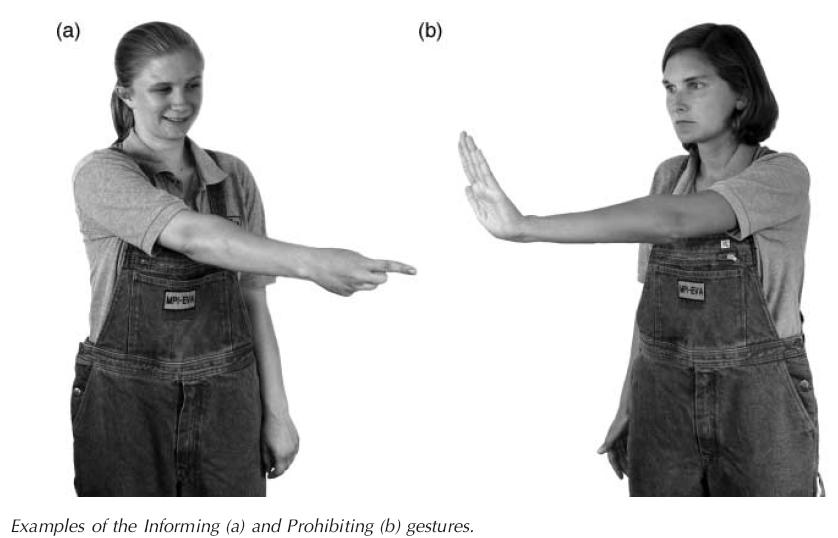
At 14 months of age for example, human children are able to successfully pass an object-choice task. In this task, children are presented with two upside-down buckets, one of which contains a toy, and the experimenter points toward the bucket where the toy is hidden. The child then turns to the right bucket and retrieves the toy. Although this task may appear simple, it is remarkable that chimpanzees fail it. In contrast to children, they fail to see the pointing gesture as a relevant cooperative signal within a shared attentional frame. Instead chimpanzees seem to think something along the lines of: “‘A bucket. So what? Now where’s the food?’ They do not understand that the pointing is intended to be ‘relevant’ to the searching as a shared activity (see Sperber & Wilson, 1986)” (Tomasello & Carpenter 2007: 122).


But this result is reversed in chimpanzees when instead of pointing cooperatively towards the bucket, the experimenter makes a prohibiting gesture by holding her arm out towards the correct container with her palm out, says something like “Don’t take this one” in a firm manner and then leaves the room. In this competitive context chimpanzees can successfully infer where the hidden reward. What is equally interesting is that 24 month old children do not retrieve the hidden toy possibly because they were better at cognitive control than 18 month old children and chimpanzees and were aware of the social and communicative conventions of the prohibiting action (Hermann & Tomasello 2006, see e.g. Miller et al. 2002, Tomasello 2008: 208ff. ).


Understanding Shared Experience

At the age they are able to solve a simple informative object-choice, infants also can keep track of who is familiar with some toy and who is not through shared experience.


In an experiment involving three toys and two experimenters, the first experimenter and the infant played together with two of the toys, then the first experimenter left the room. After that, the second exph the experimenter and the infant played with all three of the toys, but with two of them in a normal fashion and with one of them in a very excited manner. When the first experimenter then came back in ambiguously asked for “it” infants reliably gave them the toy they had an excited shared experience with. Control conditions clearly showed that the infants knew “which of these objects “we”—and not just me or you alone—had experienced in a special way in the immediate past: (Moll et al. 2008: 98). A linguistic experiment in which a mother played with three toys together with her child then left the room, and the child then played with a fourth novel toy together with an experimenter had similar results. When the mother came back and looked at the four toys and excitedly exclaimed “Oh, a modi, a modi!” the child successfully learned this as the word for the fourth novel object drawing on their experience of sharing common ground with the mother in respect to the first three toys, but not with the new toy (Akhtar et al. 1996).

Understanding Joint Commitments

In general, human children and infants seem to be much more interested in cooperation, sharing, and committing themselves to a shared goal and a shared experiential perspectives than other primates. In specific contexts chimpanzees exhibit joint, co-operative, coordinated hunting for small monkeys (Boesch & Boesch 1989), and human-raised enculturated chimpanzees successfully solve co-operative problem-solving tasks in which food could be retrieved only together with a non-competitive, familiar human adult both when it required parallel and complementary roles. When it comes to social games, however, such as one person rolling a ball down and another one catching it with a can (complementary), or making a wooden block jump on a trampoline (parallel), the chimpanzees showed no interested and played with single parts of the game set-up for themselves. 18 to 24 month-old human children on the other hand successfully took part in both the co-operative problem-solving tasks as well as the social games. What is more, in contrast to the chimpanzees the children actively tried to reengage the adult when he ceased doing his part of the co-operative activity in both problem-solving and social contexts. Children thus explicitly displayed skills of shared intentionality by being jointly committed to a shared goal with shared intentions. These skills can also be seen in the manifesting conversational and linguistic skills of children around that time (Tomasello 2003).

Pointing in Human Children and Chimpanzees


The shared intentionality infrastructure is also already present in communicative power of pantomiming and informative pointing just for the sake of sharing attention and sharing information which infants acquire around their first birthdays (Tomasello 2008: 111). These behaviours even include references to absent object or events such as something that is going on outside, happened in the past or will happen again in the future, a cup that is empty and should be filled, to something that is hidden or not present at the moment (Tomasello 2008: 116f.). Chimpanzee’s on the other hand, practically rarely point in natural contexts, and captive chimpanzees only do so when requesting something, using the human as a “social tool” (Tomasello 2006). A similar imperative behaviour has recently been observed in the wild: during grooming, chimpanzees sometimes point to a specific part of their body where they want to be scratched. (Pika & Mitani 2009). These "directed scratches" however, are also imperative in nature and not declarative.

In contrast, 12 to 18 month-olds also point co-operatively to inform others of the location of an object they are looking for. (Liszkowski et al. 2006 : 173). Generally humans infants and children have a natural tendency to be extremely cooperative in a variety of task and help others solve their problems
“even when the other is a stranger and they receive no benefit at all. However, our nearest primate relatives show some skills and motivations in this direction as well, and this suggests that the common ancestor to chimpanzees and humans already possessed some tendency to help before humans began down their unique path of hypercooperativeness.” (Warneken & Tomasello 2006: 1302 )

The evidence presented here strongly suggest that it indeed seems that social intelligence was a driving factor and the crucial foundation for what makes us unique.

But in addition, it seems that in the human lineage the “Machiavellian Intelligence Hypothesis,”, which sees social competition as the main causal factor for primate, including human brain evolution (Byrne & Whiten 1988, Humphrey 1976), does not apply across the board. Instead, it seems that the unique aspects of human cognition were driven, and are maybe even constituted by, collaboration, cooperation and the natural motivation to share experiences, intentions and perspectives, which then led to the advances in culture, technology, and higher-order cognition we see today (Moll & Tomasello 2007).

References:

Akhtar, N., Carpenter, M., & Tomasello, M. (1996). The role of discourse novelty in early word learning. Child Development, 67, 635-45.

Boesch, C. & Boesch, H. (1989): Hunting behavior of wild chimpanzees in the Taï-National Park. American Journal of Physical Anthropology 78(4), 547-573.

Byrne, R. & Whiten, A. (eds) (1988) Machiavellian intelligence: social expertise and the evolution of intellect in monkeys, apes and humans. Oxford, UK: Oxford University Press

Hare, Brian, and Michael Tomasello. (2005). Human-like social skills in dogs? Trends in Cognitive Science, 9, 439-444.

Herrmann, Esther. & Michael Tomasello, (2006). Apes' and children's understanding of cooperative and competitive motives in a communicative situation. Developmental Science, 9, 518-529

Humphrey, N. (1976) The social function of intellect. In Growing points in ethology (eds P. P. G. Bateson & R. A. Hinde), pp. 303–317. Cambridge, UK: Cambridge University Press.

Hurford, James M. (2007): The Origins of Meaning: Language in the Light of Evolution. Oxford: Oxford University Press.

Sperber, Dan and Deirdre Wilson (1995): Relevance: Communication and Cognition. Second Edition. Malden et al.: Blackwell.

Miller, Earl K., David J. Freedman and Jonathan D. Wallis (2002.) “The Prefrontal Cortex: Categories, Concepts and Cognition.” In: Phil. Trans. R. Soc. Lond. B 357: 1123–1136

Moll, Henrike and Michael Tomasello (2006): Level 1 Perspective-Taking at 24 Months of Age. British Journal of Developmental Psychology 24, 603–613

Liszkowski, U., Carpenter, M., Striano, T., & Tomasello, M. (2006). Twelve- and 18-month-olds point to provide information for others. Journal of Cognition and Development 7: 173-187.

Moll, Henrike, & Michael Tomasello. (2007) Co-operation and human cognition: The Vygotskian intelligence hypothesis. Philosophical Transactions of the Royal Society 362: 639-648.

Moll, Henrike., Richter, N., Carpenter, M., & Tomasello, M. (2008). Fourteen-month-olds know what ‘we’ have shared in a special way. Infancy, 13(1), 90-101

Tomasello, Michael (2003): Constructing A Language. A Usage-Based Approach. Cambridge, Massachusetts; London, England: Harvard University Press.

Tomasello, Michael (2008): The Origins of Human Communication. Cambridge, MA; London, England: MIT Press.

Tomasello, Michael and Malinda Carpenter (2007): “Shared Intentionality.” In: Developmental Science 10.1, 121-125.

Tomasello, Michael, Malinda Carpenter, Josep Call, Tanya Behne, and Henrike Moll (2005): Understanding and Sharing Intentions: The Origins of Cultural Cognition. In: Behavioral and Brain Sciences 28:5, 675–691.

Warneken, Felix. & Michael Tomasello, (2006). Altruistic helping in human infants and young chimpanzees. Science, 31, 1301 - 1303.


Thursday, July 1, 2010

WEIRD People and BIZARRE Chimps

The article "the weirdest people in the world?" (which I already mentioned last year, here), has finally been published in the current issue of the Behavioral and Brain Sciences (subscription needed, preprint can be found here).

In this article, Joseph Henrich, Steven J. Heine and Ara Norenzayan from the University of British Columbia in Vancouver, Canada, argue that
"Behavioral scientists routinely publish broad claims about human psychology and behavior in the world’s top journals based on samples drawn entirely from Western, Educated, Industrialized, Rich, and Democratic (WEIRD) societies."
Henrich et al. question whether these 'standard' subjects are really representative of homo sapiens as a species and instead hold that there is a substantial variability across cultures in domains such as
"visual perception, fairness, cooperation, spatial reasoning, categorization and inferential induction, moral reasoning, reasoning styles, self-concepts and related motivations, and the heritability of IQ."
The data they review indicate that both adults and children living in WEIRD societies
"are among the least representative populations one could find for generalizing about humans."
This position is sure to cause much debate, especially given that the article contains such tongue-in-cheek parts as mentioning that psychologists would surely bristle if the premier journal in social psychology, the "Journal of Personality and Social Psychology", would be renamed to more accurately reflect its main sample: "Journal of Personality and Social Psychology of American Undergraduate Psychology Students" (Henrich et al. 2010: 63)

This is why the target article is accompanied by 28 commentaries, which interestingly, are too a large extent quite positive. What is less surprising is that many of the commentaries use the acronym WEIRD for puns or come up with their own ones.

Here's a sample of the titles:
  • Weird people, yes, but also weird experiments (Baumard & Sperber 2010)
  • Weirdness is in the eye of the beholder (Bennis & Medin 2010)
  • It’s not WEIRD, it’s WRONG: When Researchers Overlook uNderlying Genotypes, they will not detect universal processes (Gaertner et al. 2010)
  • Wired but not WEIRD: The promise of the Internet in reaching more diverse samples (Gosling et al. 2010)
  • ODD (observation- and description-deprived) psychological research (Rai & Fiske 2010)
  • In a very interesting article, Leavens et al. (2010) claim that "BIZARRE chimpanzees do not represent “the chimpanzee.”" They caution that great apes from "Barren, Institutional, Zoo, And other Rare Rearing Environments" (BIZARRE) differ cognitively from great apes living in the wild. This makes it dangerous to make generalized statements about the cognitive capacities of great apes that are based mainly on experiments with BIZARRE apes. This is also the main thrust of the commentary by primatologist Christophe Boesch.
Leavens et al. (2010: 101) also have a very interesting graph comparing the pointing behaviors of wild chimpanzees, instituationalized chimpanzees and home-raised or language trained-chimpanzees, which varies markedly from one another. Rearing history and early development thus seem to be able to influence the pointing behaviour and interaction skills of chimpanzees quite heavily.

This is especially important given that researchers like Michael Tomasello and others argue that pointing declaratively to help, inform, and share motives and attitudes in a rich interactive setting characterized by joint attention, shared intentionality, common ground, as well as role- and perspective-taking is the key human cognitive specialization that makes us human and separates us from the other apes.

Most strikingly, in Leavens et al. 's (2010) analysis, chimpanzees also point declaratively, but this is contested by other researchers (e.g. Tomasello 2006, Tomasello 2008, see here). The main question here is how to understand "declarative pointing" and the cognitive capacities behind it, but this is a difficult topic. For Tomasello "declarative pointing" involves "a declarative motive" which
"assumes a partner with the psychological states of interest and attention, which one can then attempt to share."
And according to Tomasello, chimpanzees lack this understanding (Tomasello 2006).
Leavens et al. on the other hand define "declarative pointing" as
"Pointing to draw somebody’s attention to an object or event; includes responses to queries, such as pointing to an object when asked where that object is."
Tomasello would argue that the latter part does not belong into the category of declarative pointing as these kinds of gestures are not to be seen as as truly declarative or informative, as they are more
„recognitory or classificatory, as the ape simply recognizes something and produces the associated sign in recognition“ (Tomasello 2008: 38)."
But as Leavens et al. (2010) also claim that chimpanzees point "to draw somebody’s attention to an object or event" and not only as a direct classificatory reaction, this stands in direct contrast to Tomasello's position. I'm very interested in how this debate will continue.

Friday, August 14, 2009

Language, Thought, and Space: (IV) Comparing Different Cultures.

I wanted to continue posting on Stephen Levinson’s 2003 book, but unfortunately, I only have very limited access to the internet right now, and as my year abroad at the University of Nottingham is over, I don’t have access to the e-book version anymore (The Library at the University of Heidelberg has a copy of the book but I’m currently at home and can’t get it from there either).

Instead, I’ll post about a fascinating study done by people from the Max-Planck-Institute for Psycholinguistics (Nijmegen, Netherlands) and people from the Max-Planck-Institute for Evolutionary Anthropology (Leipzig, Germany) that pretty much blew me away (quite literally so: it pretty much destroyed a central assumption of the received theory of cognitive perspective that I wanted to work on).

As I already said, work done by Stephen Levinson and others on how different cultures talk about and conceptualise space has shown that not all of them employ a bodily, egocentric frame of reference or coordinate system as their dominant organizing principle for their experiences and thoughts. Speakers of “several indigenous languages of Australia, Papua New Guinea, Mexico, Nepal, and south West Africa,” in contrast, organize the axes of their dominant coordinate system by absolute principles such as fixed landmarks (e.g. uphill vs. downhill) or cardinal directions (e.g. move the chair to the north). In addition, there are also languages that primarily use “intrinsic,” object-centred Frames of References, such as in “The dog is at the front of the library.”
In a set of clever experiments Levinson and his colleagues have also shown that speakers of relative and absolute languages differ in how they solve non-linguistic spatial tasks. For example, in the “motion-maze task” (Pederson & Schmitt 1993) participants see a toy move on a table. They are then rotated 180° and asked to recognize, on a table with a maze-like diagram, the “the path traversed from within a maze-like diagram containing both absolute and relative possibilities“ (Levinson et al. 2002).

Interestingly, speakers of relative languages such as Dutch or Japanese recognize the path based on the relative frame of reference they employ in their language whereas speakers of absolute languages such as the Australian Aboriginal language Arrernte or Tzeltal recognize the path based on their absolute frame of reference (Levinson et al. 2002, Levinson 2003).
Results like this were achieved on a wide array of space-based tasks, so the overall findings that relative speakers prefer relative FoR in spatial tasks and that absolute speakers prefer absolute FoRs seems to be quite robust. (Haun et al. 2006).
In a recent set of experiments Haun et al. (2006) tested how soon a cognitive bias in spatial cognition manifests itself. They tested 7-11 age year old children from a Dutch village, who mainly use an egocentric FoR) and from a Khoisan hunter–gatherer community in Namibia called =/= Akhoe Hai||om (to be honest, I don’t have any idea how to pronounce this), who almost always use absolute spatial descriptions.
They also tested adults of both cultures “to see whether differences were not only initial variations of an emerging cognitive skill but were actually stable across the life span.”
What they did was the following: The subject was placed in front of a table on which there were five identical cups in a “five dice”-constellation:
(X = Cups | = Screen E= Experimenter O=Hidden Object)


They were then shown the location of an object that was hidden under one of the cups.


In the next step, the Subject was turned 180° and brought to an identical table behind the screen:

Then, and this is the crucial bit, they were asked to indicate the spot where they thought the object was hidden this time. In the experiment, there were three conditions. First, an egocentric one: if the object was hidden to the left of the subject, it was also hidden to the subject’s left after she was rotated to her new position.


Secondly, there was an object-centred condition in which the “hiding and finding cups maintained position in relation to a salient landmark between the two tables, namely the screen or the experimenter” (Haun et al. 2006 : 17659).


And finally, there was a geocentric condition where, if the hiding cup was to the north-west, it would also be the to the north-west in the rotated position.


After repeated trials on all the conditions the following picture emerged: Hai||om children and adults were faster to learn and made the fewest errors in the absolute condition and Dutch children and adults were best in the egocentric condition.
“This correlation is fully robust by age 8 and persists into adulthood. In sum, Dutch and Hai||om subjects varied in their preferred cognitive strategy to solve a spatial relational learning task, and their preference matched the preferred mode of description in their respective language” (Haun et al. 2006 : 17570).

Although it is quite difficult to interpret these results in terms of the relationship between language and thought (see e.g. Pederson 2007, Palmer 2007: 1059ff.), the results are certainly thrilling and give rise to a further question: which of these frames of reference is the primary and basic one that infants have? Is there a cognitive default setting that we and the other great apes inherited from our last common ancestor which is only later overridden by cultural factors?
I’ll return to this question in my next post tomorrow.

References:

Haun, Daniel B. M., Christian J. Rapold, Josep Call, Gabriele Janzen, and Stephen C. Levinson. 2006. “Cognitive Cladistics and Cultural Override in Hominid Spatial Cognition.” In: PNAS 103: 17568–17573.

Levinson, Stephen C. 2003. Space in Language and Cognition: Explorations in Cognitive Diversity. Cambridge: Cambridge University Press.

Levinson, Stephen C., Sotaro Kita, Daniel B.M. Haun, Björn H. Rasch. 2002. “Returning the Tables: Language Affects Spatial Reasoning.” In: Cognition 84: 155–188.

Palmer, Gary B. 2007. “Cognitive Linguistics and Anthropological Linguistics.” In: The Oxford Handbook of Cognitive Linguistics, ed. by Dirk Geeraerts and Hubert Cuyckens. Oxford: Oxford University Press. 1045-1073.

Pederson, Eric. 2007. “Cognitive Linguistics and Linguistic Relativity.” In: The Oxford Handbook of Cognitive Linguistics, ed. by Dirk Geeraerts and Hubert Cuyckens. Oxford: Oxford University Press. 1012-1044.

Pederson, Eric & B. Schmitt 1993. Eric’s maze task. In Cognition and Space Kit Version 1.0 (pp. 73–76).Nijmegen: Cognitive Anthropology Research Group at the Max Planck Institute for Psycholinguistics.

Friday, July 17, 2009

Language, Thought, and Space (III)


In the second chapter of his book, Stephen Levinson discusses a concept that has been crucial to this blog: frames of reference. (see e.g. these posts) The term as it is used today was coined by Gestalt theorists of perception in the 1920s and was used to signify the steady and constant background against which other objects could be made out and identified. It can be defined as “‘a unit or organization of units that collectively serve to identify a coordinate system with respect to which certain properties of objects, including the phenomenal self, are gauged’ (Rock 1992: 404, emphasis in Levinson 2003: 24).

Frames of references seem to be highly similar across modalities such as vision, touch, gesture, and language. Without these structural similarities (or ‘isomorphisms’) “we could not reach to what we see, or talk about what we feel with our hands, or give route descriptions in language and gesture.” (Levinson 2003: 25). There are, however, also differences: vision is viewer-centred, and touch and grasp are object-centred.

In general, frames of references can be classified by the following distinctions.
Absolute vs. Relative. Psychologically, the received view is that we organize our spatial thinking in relation to objects and ourselves. The frame of reference is thus relative to our own ego-centric bodily coordinates. An absolute frame of reference, on the other hand would consist of fixed angles with coordinates that do not depend on our personal egos as anchoring. And as we have seen, contrary to the received view, both kinds of frames of references are employed in the world’s languages. (Levinson 2003: 27f.).
Similar, but not completely identical is the differentiation between egocentric and allocentric frames of reference. This designates a difference
"between coordinate systems with origins within the subjective body frame of the organism, versus coordinate systems centred elsewhere (often unspecified).” (Levinson 2003: 28).

Our mental maps of our environment and our place are either egocentric or allocentric and landmark-based, including the relations, distances and angles between different landmarks, or allocentric and based on “fixed bearings.” These distinctions can not only be found in the world’s languages, but are also used by neuroscientists when they look at the mental map-building capacities of animals.
In studies of conceptual development it was also argued, following Jean Piaget, that for a long time ‘egocentric’ frames of reference are primary and that children switched to ego-centric frames of reference only to a much later date.

In studies of the visual system we often find a distinction between viewer-centred vs. object-centred. If we identify an object we are also able to mentally rotate it and imagine how it would look from another angle. This means that the retinal impression of the viewer gets interpreted and classified in a more abstract object-centred frame of reference during perception.
Another distinction made when looking at visual imagery and visual perception is that between orientation-bound vs. orientation-free. Orientation-bound information changes with perspective and change of location, whereas orientation-free information does not change. For example, when we rotate a d it can become a b, the information changes. But a ball looks the same from all perspectives and the information is thus orientation-free.
The most important distinction for psychology and language however, is the difference between
“viewer-centred frames, object-centred frames, and environment-centred frames of reference.Ina viewer-centred frame, objects are represented in a retinocentric, head-centric or body-centric coordinate system based on the perceiver’s perspective of the world. In an object-centred frame, objects are coded with respect to their intrinsic axes. In an environment-centred frame, objects are represented with respect to salient features of the environment, such as gravity or prominent visual landmarks. “ (Carlson-Radvansky & Irwin 1993: 224).
Levinson called these the relative, intrinsict and absolute frames of reference. (Levinson 2003: 33).

The distinctions made in various disciplines at times are quite confusing and there are many conflicting positions. However, a broad differentation such as this seems valid.
Next, we have to distinguish between three levels on which different frames of references can be constructed: perceptual, conceptual, and linguistic. There is especially much diversity on the linguistic level, which will be discussed in my next post. As I'm going home tomorrow I don't really know when I'll have access to the internet again, but I hope it wont't be too long.

Reference:
Carlson-Radvansky, L.A. and Irwin, D.A. (1993): Frames of reference in vision language: Where is above? Cognition
46: 223-244

Levinson, Stephen C. (2003) Space in Language and Cognition : Explorations in Cognitive Diversity. West Nyack, NY, USA: Cambridge University Press.

Rock, I. (1990), The frame of reference, in I. Rock (ed.), The legacy of Soloman Asch, pp. 243– 268. Hillsdale, NJ: Lawrence Erlbaum.

Thursday, July 16, 2009

Language, Thought, and Space (II)

Spatial orientation is crucial when we try to navigate the world around us. It is a fundamental domain of human experience and depends on a wide array of cognitive capacities and integrated neural subsystems. What is most important for spatial cognition however, are the frames of references we use to locate and classify ourselves, others, objects, and events.

Often, we define a landmark (say ourselves, or a tree, or the telly) and then define an object's location in relation to this landmark. (the mouse is to my right, the bike lies left of the tree, my keys have fallen behind the telly). But as it turns out, many languages are not able to express a coordinate system with the meaning of the English expression “left of.” Instead, they employ a compass-like system of orientation.

They do not use a relative frame of reference, like in the English “the cat is behind the truck” but instead use an absolute frame of reference that can be illustrated in English by sentences such as “the cat is north of the truck.” (Levinson 2003: 3). This may seem exotic for us, but for many languages it is the dominant – although often not the only – way of locating things in space.

What are the cognitive consequences of this? Levinson argues that “
the choice of a predominant frame of reference in language correlates with, and probably determines, many other aspects of cognition, from memory, to inference, to navigation, to gesture and beyond. “ (Levinson 2003: 3).

Levinson has done much work on two languages which feature absolute frames of references:
1. Guugu Yimithirr, an Australian Aboriginal language. Levinson recounts how a Guugu Yimithirr speaker once warned him of an army ant “north of his” foot, or how another one told him where to find the frozen fish in a store that was 45 kilometres away. He pointed to his left and Levinson, just as all speakers of Indo-European and many other languages would probably do, thought he meant that Levinson would find the frozen fish on his right-hand side when he entered the shop. But in fact, he had pointed north-east and intended to communicate to Levinson that he would find the frozen fish in the north-east corner of the shop.

Größere Kartenansicht

2. Tzeltal, a Mayan language. In Tzeltal, speakers use the hills that surround them as points of reference. If they are out of the hills, they still project their frame of reference on their environment. So a speaker asking “Is the hot water in the uphill tap?” in an unfamiliar hotel out of the hills would mean by this ‘Is the hot water in the tap that would lie in the uphill (southerly) direction if I were at home?’ (Levinson 2003: 4).

Größere Kartenansicht

Levinson was particularly impressed by a Guugu Yimithirr speaker who, when referring to a absent person, seemingly pointed at himself but in fact pointed to the place the person had lived before. For Levinson, this indicates that
“in some striking way, the ego has been reduced to an abstract point in space. (Levinson 2003: 5)”

These experiences fit perfectly into and are supported by a more thorough and experimental investigation of this matter. But they fly in the face of much of traditional western thinking on the topic, including the consensus on the nature of spatial thinking in much of cognitive science, psychology, and linguistics which held that it was organized in a relative, egocentric and anthropocentric manner. (Levinson 2003: 10f.).

And in the chapters of his book Levinson sums up a robust body of data that lend support to his thesis that spatial cognition may be differently organised in different cultures, and that the body may not be the fundamental source of our spatial concepts, neither developmentally nor cross-culturally.

However, there are still strong universal trends in cognition in the domain of space. According to Levinson the best way to accommodate all these findings is to concede that human cognition may employ several modes of internal representation and that there is no reason to assume that there is only one form of mental representation. If we accept this view, it seems much more logical to state that the internal representations accessed by and linked to language and cultural practices are in some way influenced and shaped by these linkages. (Levinson 2003: 21f.).
Levinson sums up the key issues that recur throughout his book as follows:

  • “What are the ‘natural’, pre-linguistic or innate, spatial concepts in human cognition? How abstract are they? Why does spatial thinking have a centrality in human cognition?
  • What is the role of bodily axes and coordinates in spatial cognition?
  • What is the nature of the relation between linguistic categories and non-linguistic concepts, both in general and in the spatial domain? Are there a multiplicity of underlying representations, or one multimodal representation of space? If the latter, what is its relation to spatial semantics?
  • How much linguistic diversity is there in this domain, not only in expressive form, but underlying semantic parameters? Given that there is diversity, what linguistic universals can be stated in this area?
  • Given semantic diversity, what happens to the underlying cognition? Does it remain a universal constant, translated into various restricted linguistic concepts, or does it adapt to the language it must locally support?
  • What are the general implications from the spatial domain for the relation between language and human thinking?” (Levinson 2003: 22f.)

References:

Levinson, Stephen C. (2003) Space in Language and Cognition : Explorations in Cognitive Diversity. West Nyack, NY, USA: Cambridge University Press.

Wednesday, July 15, 2009

Language, Thought, and Space (I)


I know I still haven't written my third post on Lewontin's paper in which he criticises inquiries into the evolution of language and cognition and it will be some time until I'll be able to post it as I'm going back home on Saturday and won't haven internet access for more than a month.

But in the next couple of days I want to write something about different: How different cultures speak about and conceptualize space.
In my opinion, this is a very fascinating avenue of linguistic research that gives much insight into the nature of language and cognition as well as their relationship. In addition, it also presents us with new facts and considerations when we try to study the evolution of these traits.
By studying language and cognition cross-culturally we come to the problem of language evolution from the other way so to speak.

I will focus on the work of the Max-Planck-Institute for Psycholinguistics in Nijmegen, Netherlands and especially on the introductory part of Stephen Levinson's (2003) book "Space in Language and Cognition." I've started reading it because I wanted to improve my knowledge of some aspects of the cognition-oriented strands of linguistics and anthropology I unfortunately know way too little about.

I’ve written about the idea of frames of references and cognitive coordinate systems before , I haven’t said much about linguistic data that bears on this question. More generally, I, following other researchers, have argued that cognition and cognitive representations of communicative interactions are to a large part spatial in nature or at least analogous to spatial thinking. But research done by the people at the Max-Planck-Institute for Psycholinguistics in Nijmegen, Netherlands and others has shown that there is a surprising diversity in linguistic frame of references across cultures.

What exactly does this mean for any account of cognition? What we have here is of course related to the contentious issue of the relation of language and thought. Generally there people who tend too emphasize the importance of a Language of Thought over language itself (e.g. cognitivism), with others tending toward the view that language and culture shape your cognitive style to a significant amount (e.g. linguistic relativism, linguistic determinism). These theorists can be called “lumpers” who do not see it necessary to distinguish between the semantic content of a language and underlying conceptual representations, and “splitters” who insist on this distinction. (Levinson 1997: 13f.)

The issue is often seen as a black and white matter, with Benjamin Lee Whorf being portrayed as the bad guy who had a way too extreme view. This, however, is misguided, as Whorf’s main interest was not to advocate any idea of linguistic determinism per se but instead to stress the importance of how perspectives embodied in a language influence what we pay attention to in a situation and also how we conceptualise it: “‘users of different grammars are pointed by their grammars toward different types of observations and different evaluations of externally similar acts of observation, and hence are not equivalent as observers but must arrive at somewhat different views of the world’” (Whorf 1956: 221).

This is not to say that language is a prison we can’t get out of. But, as language and social practices can be said to embody certain perspectives on the world, it is reasonable to argue that a child growing up in a certain community will also learn to adopt and construe these perspectives during her cognitive development. As language is a primary source that introduces children to new ways of organizing the world around them it stands to reason that the concepts and viewpoints expressed in a language have a significant impact on cognitive representations.

Of course research on the non-linguistic cognition of infants and non-human primates has shown that their mental representations are already surprisingly sophisticated and complex. Some of these cognitive capacities are certainly specified innately or at least helped by innate biases. Others may emerge due to the nature and early imprint of cultural interaction. But some concepts, namely abstract, relational ones, seem to be absent from non-human cognition completely, and in humans seem to be provided and picked up primarily by and through language during cognitive development. In fact, research on infant and childhood cognition supports the fact that the acquisition of relational concepts with the help of language may be one of the key factors that made us “so smart” (Gentner 2003, Penn et al. 2008).

If we bear this in mind, the question then is not whether language influences or determines thought, but to clarify the interactions and relationship between innate biological propensities, the environment, language and other cultural practices. If for example, we allow for multiple modes of representation in cognitive processing we may get a much clearer view on the issue. If, as mentioned above, we see semantic representations and conceptual representations as different levels of representation we can accommodate the variety of semantic distinctions in different levels with maintaining some form of ‘psychic unity of mankind’ with shared atomic concepts across our species. (Levinson 1997)

In my next post I’ll write about how the research done by the Max-Planck-Institute for Psycholinguists on the relationship between cross-linguistic differences in descriptions of space sheds light on this topic. I will draw on the 2003 book Space in language and cognition: explorations in cognitive diversity by Stephen C. Levinson, the director of the language and cognition group at the institute, in which he sums up much of the research that was done there over the years.

References:
Gentner, D. (2003). Why we’re so smart. In D. Gentner and S. Goldin-Meadow (Eds.), Language in mind: Advances in the study of language and thought (pp.195-235). Cambridge, MA: MIT Press.

Levinson, Stephen C. (1997) From outer to inner space: Linguistic categories and non-linguistic thinking. In E. Pederson & J. Nuyts, eds., With Language in Mind: the Relationship Between Linguistic and Conceptual Representation, 13-45. Cambridge: Cambridge University Press.

Levinson, Stephen C. (2003) Space in Language and Cognition : Explorations in Cognitive Diversity. West Nyack, NY, USA: Cambridge University Press.

Penn, Derek C, Keith J. Holyoak. and Daniel J. Povinelli (2008): Darwin's mistake: Explaining the discontinuity between human and nonhuman minds. In: Behavioral and Brain Sciences (31:2): 109-130.

Whorf, B.L. (1956,) Language, thought and reality, Cambridge, MA: MIT Press.